
Book view
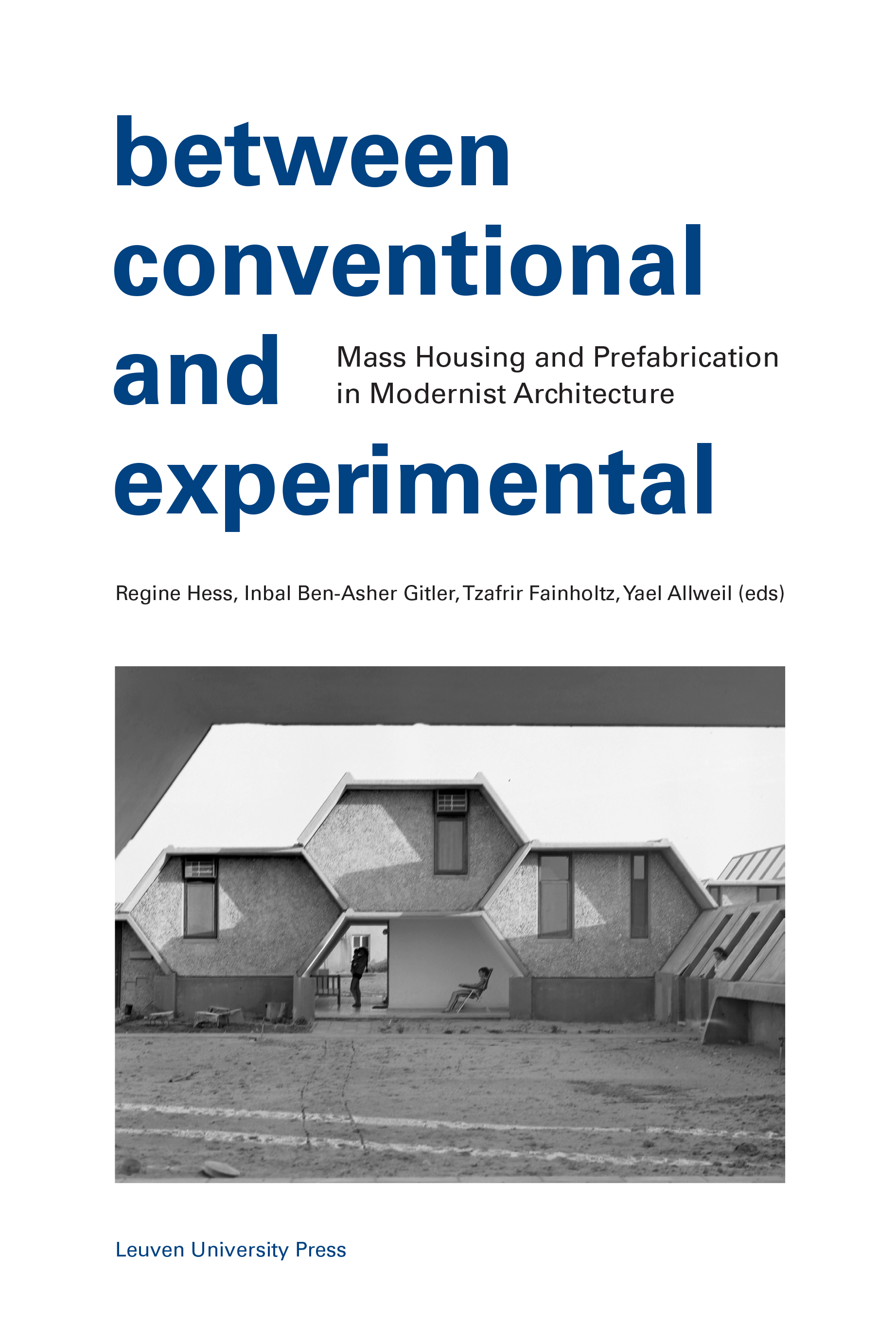
Between Conventional and Experimental
Mass Housing and Prefabrication in Modernist Architecture
Edited by Regine Hess, Inbal Ben-Asher Gitler, Tzafrir Fainholtz, Yael Allweil
Book information
- Publisher
- Leuven University Press
- Publication
- Forthcoming 10 September 2024
- Place
- Leuven, BE
- Catalogue record
- View in the catalogue
Abstract
How conventional and experimental prototypes and series created an architecture for all.
Mass housing and prefabrication shaped global modernist architecture like no other aspect of industrialised construction. This book offers a comprehensive exploration of how both conventional and experimental prototypes and series gave rise to an architecture for all, often responding to crises, the imperatives of nation-building, and housing shortages by rapidly developing, distributing, and assembling structures.
The book’s contributions, with a geographical emphasis on Europe and Israel, offer innovative approaches to the history of prefabrication. Some explore partially unearthed empirical ground, such as cases from Finland and Sweden, while others offer a fresh interpretation of prefabrication’s role in the history of global architecture and planning after WWII, notably in the USSR and Italy. The chapters encompass a broad spectrum of topics, including colonial expansion, international collaboration, and the achievements and setbacks of industrialised design. The authors scrutinise the cultural impact of mass housing and prefabrication, tracing this influence through exhibitions, memory culture, and typologies, ultimately concluding with an outlook on the preservation and repair of structures and their adaptation for the future.
Within the broader context of transnational and regional research, Between Conventional and Experimental presents novel and forward-thinking approaches to prefabrication and mass housing. Drawing from transnational architectural history, construction history, housing studies, monument preservation, and exhibition studies, it effectively highlights the profound relevance of prefabrication history to our understanding of the cultural and material history of the built environment.
Contributors: Mia Åkerfelt (Åbo Akademi University, Turku), Yael Allweil (Technion Israel Institute of Technology), Inbal Ben Asher-Gitler (Sapir Academic College, Ashkelon/ Ben Gurion University of the Negev, Beer Scheva), Angelo Bertolazzi (University of Padua), Tamara Bjažić Klarin (University of Zagreb), Tzafrir Fainholtz (Technion Israel Institute of Technology), Alberto Franchini (Technical University Munich/Polytechnic University of Milan), Ilaria Giannetti (Sapienza, University of Rome), Regine Hess (ETH Zurich), Silke Langenberg (ETH Zurich), Daphna Levine (Technion Israel Institute of Technology), Stefania Mornati (Sapienza, University of Rome), Uta Pottgiesser (TU Delft), Maryia Rusak (Oslo School of Architecture and Design), Liat Savin Ben Shoshan (Technion Israel Institute of Technology), Maria Tassopoulou (Technical University of Athens), Anna Wilczyńska (Estonian University of Life Sciences/ Warsaw University of Life Sciences).
Ebook available in Open Access. This publication is GPRC-labeled (Guaranteed Peer-Reviewed Content).
Where its authors and editors are based
Countries of the institutions the book's authors, editors and chapter authors were affiliated to when it was published.
- AUTHORS / EDITORS
- CITATIONS Phase 2
- USAGE Phase 3
No affiliations with a known country in these years yet.
About this data
These figures cover 1 work. Each value comes from the most trusted source that has it; a correction made by OBC staff outranks every source.
| Source | Confidence | Works |
|---|---|---|
| Thoth | 90 / 100 | 1 |
| Works with a publication date | 100% |
|---|---|
| Works with a DOI | 100% |
| Works with a funder recorded | 100% |
| Authors with an affiliation | 0% |
Countries come from the institution each author was affiliated to when they published, as recorded in ROR. A country is never guessed, so authors without a matched institution are not counted on the maps.
Funders come from OpenAlex for articles and Thoth for books, where publishers recorded them. Not every work records one, so a funder's figures show what is recorded, not everything it funded.
Chapters count as works: their authors and editors, and the countries of their institutions, are in every figure where Thoth records an affiliation for them.
Citations (Phase 2) and usage (Phase 3) are not collected yet.