
Book view
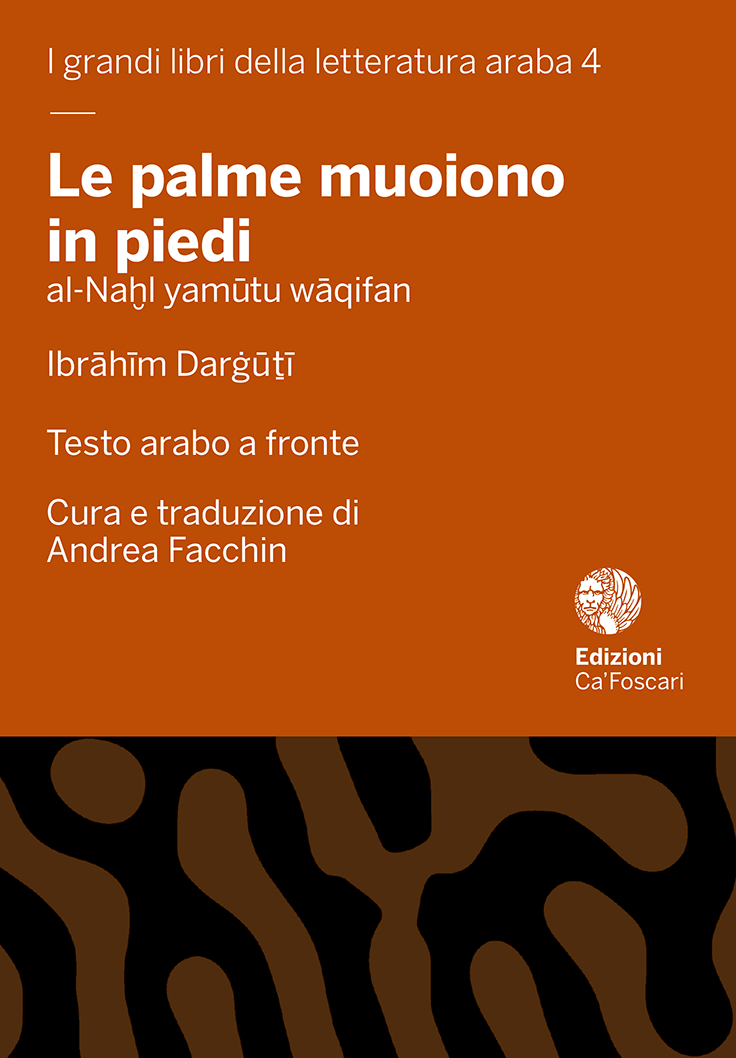
Palm Trees Wither Upright
al-Naḫl yamūtu wāqifan
Edited by Andrea Facchin; by Ibrāhīm Darġūṯī
Book information
- Publisher
- Edizioni Ca' Foscari
- Publication
- Published 11 November 2021
- Place
- Venice, Italy
- Series
- I grandi libri della letteratura araba
- Catalogue record
- View in the catalogue
Abstract
al-Naḫl yamūtu wāqifan (Palm Trees Wither Upright) is the first work by Tunisian writer Ibrāhīm Darġūṯī, born in El-Mahassen (Tozeur) in 1955, proponent of the experimentalism and magical realism, and known all over the Arab world for his pungent writing style. The work was published in Sfax in 1989, and is a collection of short stories devoted to the local life of al-Ǧarīd region, in southern Tunisia; to its traditions, distinctive traits and, at times, to imagination, creating a unique mixture, which is representative of Darġūṯī’s literature. Men, the desert, and palm trees are the essential elements, the three primary colours of this literary text. Stories unfold around this triad and through them its author introduces the many facets of local reality. “A hand full of sun for ʿAzīz” or “Lion’s paw” reveal an intimate relationship between nature, represented by the palm grove, and the inhabitants of that land; a sort of tacit agreement for which one has promised to take care of the other since the dawn of time. Other stories explore all the repressive elements of the system: class differences, hunger, humiliation, tyranny; in short, the loss of fundamental rights. In this sense, Darġūṯī’s work is not remission or defenceless immobility in the face of the injustices perpetrated by man on his neighbour; on the contrary, it is pure rebellion. al-Naḫl is a vivid mixture in which multiple traditions blend. It is a set of fragments of an Arab, Tunisian or Saharan setting fairy tale, or of the Islamic cultural heritage. It shows the scars left by French colonialism, or the challenge of man facing the change of times. It is a condemnation of all kinds of injustice, a cry of anguish and restlessness for the troubles of everyday life. It is a glimpse of the Ǧarīd with its mysteries, the desert that claims men’s lives, the almost metaphysical landscapes of a salt lake that was once a sea. It is the first work by Darġūṯī translated into Italian.
Where its authors and editors are based
Countries of the institutions the book's authors, editors and chapter authors were affiliated to when it was published.
- AUTHORS / EDITORS
- CITATIONS Phase 2
- USAGE Phase 3
| Country | Authors / editors |
|---|---|
| Italy | 1 |
About this data
These figures cover 1 work. Each value comes from the most trusted source that has it; a correction made by OBC staff outranks every source.
| Source | Confidence | Works |
|---|---|---|
| Thoth | 90 / 100 | 1 |
| Works with a publication date | 100% |
|---|---|
| Works with a DOI | 100% |
| Works with a funder recorded | 0% |
| Authors with an affiliation | 50% |
| Affiliations matched to an institution (ROR) | 100% |
| Affiliations with a country | 100% |
Countries come from the institution each author was affiliated to when they published, as recorded in ROR. A country is never guessed, so authors without a matched institution are not counted on the maps.
Funders come from OpenAlex for articles and Thoth for books, where publishers recorded them. Most works record none, so a funder's figures show what is recorded, not everything it funded.
Chapters count as works: their authors and editors, and the countries of their institutions, are in every figure where Thoth records an affiliation for them.
Citations (Phase 2) and usage (Phase 3) are not collected yet.