
Book view
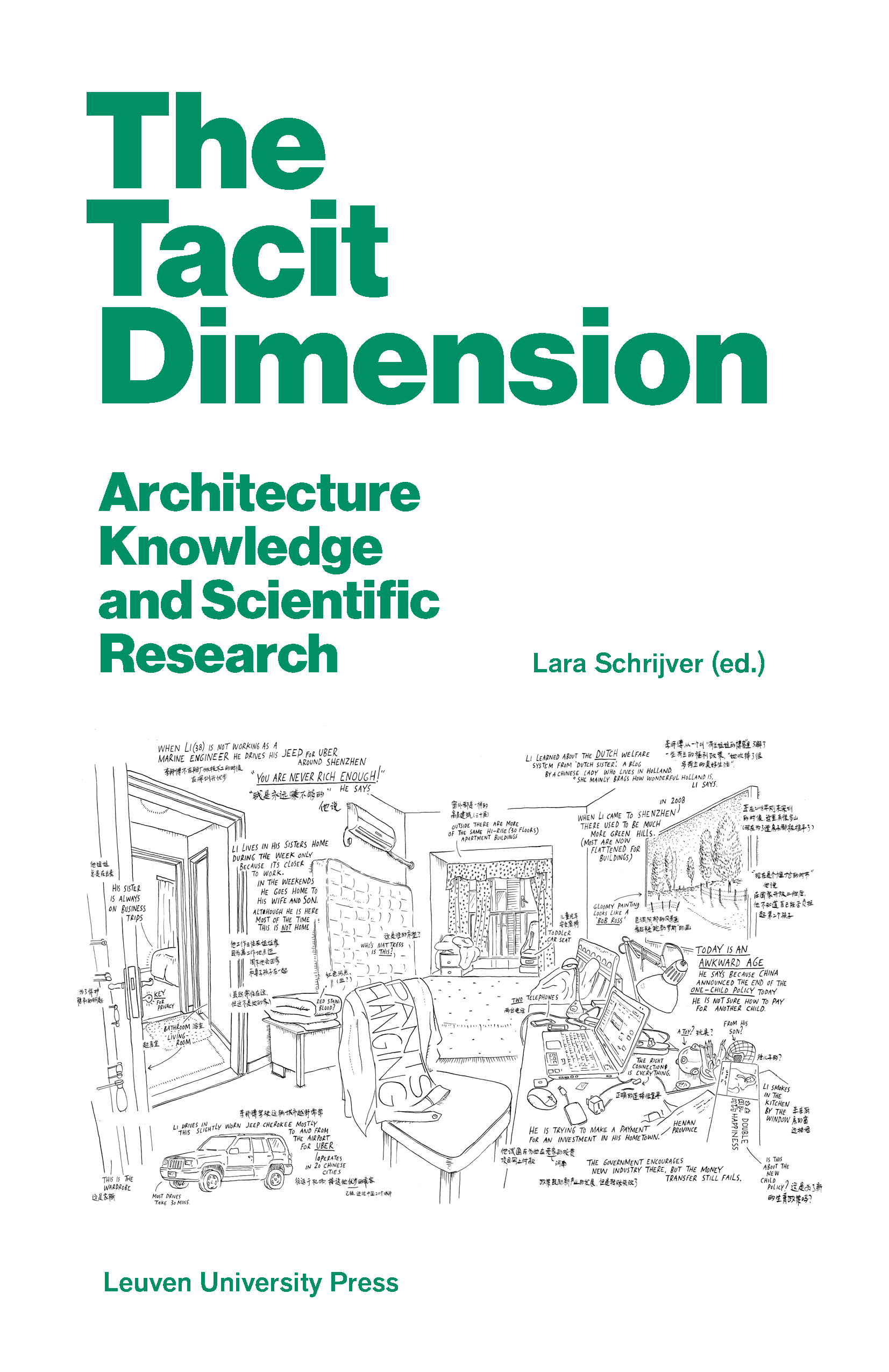
The Tacit Dimension
Architecture Knowledge and Scientific Research
Edited by Lara Schrijver
Book information
- Publisher
- Leuven University Press
- Publication
- Published 3 May 2021
- Place
- Leuven, BE
- Catalogue record
- View in the catalogue
Abstract
Understanding the multitude of knowledges that constitute architectural thinking, designing and making
In architecture, tacit knowledge plays a substantial role in both the design process and its reception. The essays in this book explore the tacit dimension of architecture in its aesthetic, material, cultural, design-based, and reflexive understanding of what we build. Tacit knowledge, described in 1966 by Michael Polanyi as what we ‘can know but cannot tell’, often denotes knowledge that escapes quantifiable dimensions of research. Much of architecture’s knowledge resides beneath the surface, in nonverbal instruments such as drawings and models that articulate the spatial imagination of the design process.
Awareness of the tacit dimension helps to understand the many facets of the spaces we inhabit, from the ideas of the architect to the more hidden assumptions of our cultures. Beginning in the studio, where students are guided into becoming architects, the book follows a path through the tacit knowledge present in materials, conceptual structures, and the design process, revealing how the tacit dimension leads to craftsmanship and the situated knowledge of architecture-in-the-world.
Contributors: Tom Avermaete (ETH Zürich), Margitta
Buchert (Leibniz-Universität Hannover), Christoph Grafe (Bergische Universität
Wuppertal), Mari Lending (The Oslo School of Architecture and Design), Angelika
Schnell (Academy of Fine Arts Vienna), Eireen Schreurs (Delft University of
Technology), Lara Schrijver (University of Antwerp)
Ebook available in Open Access.
This publication is GPRC-labeled (Guaranteed Peer-Reviewed Content).
Where its authors and editors are based
Countries of the institutions the book's authors, editors and chapter authors were affiliated to when it was published.
- AUTHORS / EDITORS
- CITATIONS Phase 2
- USAGE Phase 3
No affiliations with a known country in these years yet.
About this data
These figures cover 1 work. Each value comes from the most trusted source that has it; a correction made by OBC staff outranks every source.
| Source | Confidence | Works |
|---|---|---|
| Thoth | 90 / 100 | 1 |
| Works with a publication date | 100% |
|---|---|
| Works with a DOI | 100% |
| Works with a funder recorded | 100% |
| Authors with an affiliation | 0% |
Countries come from the institution each author was affiliated to when they published, as recorded in ROR. A country is never guessed, so authors without a matched institution are not counted on the maps.
Funders come from OpenAlex for articles and Thoth for books, where publishers recorded them. Not every work records one, so a funder's figures show what is recorded, not everything it funded.
Chapters count as works: their authors and editors, and the countries of their institutions, are in every figure where Thoth records an affiliation for them.
Citations (Phase 2) and usage (Phase 3) are not collected yet.