
Book view
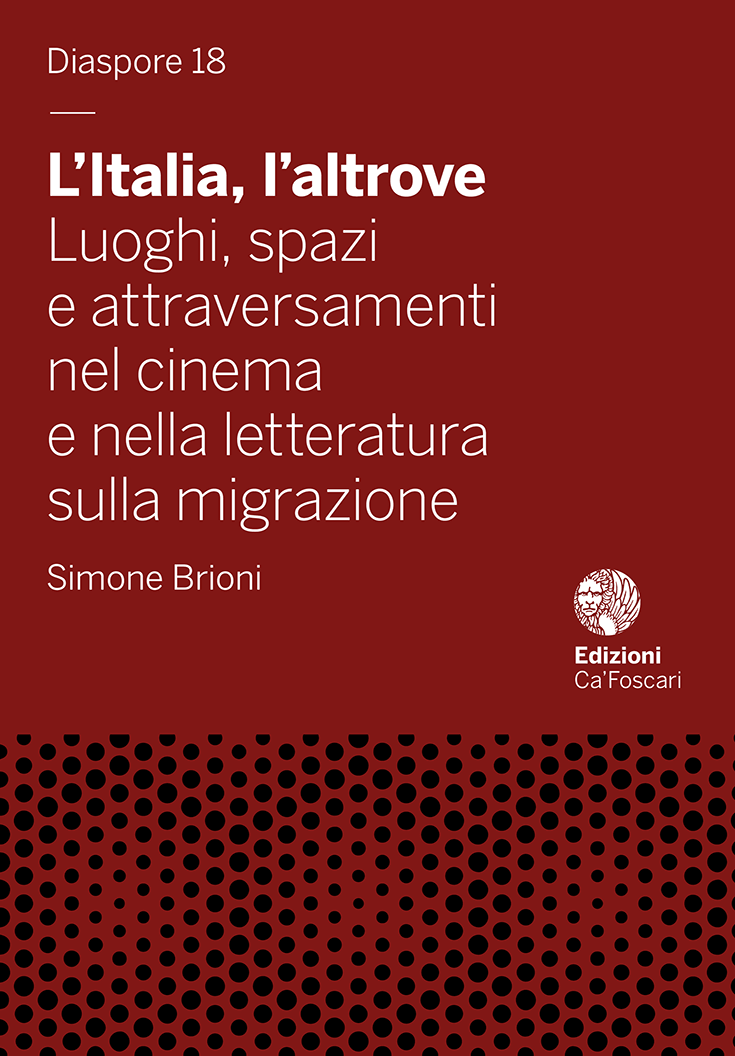
Italy, Elsewhere
Places, Spaces and Crossings in Cinema and Literature on Migration
Book information
- Publisher
- Edizioni Ca' Foscari
- Publication
- Published 18 October 2022
- Place
- Venice, Italy
- Series
- Diaspore
- Catalogue record
- View in the catalogue
Abstract
This monograph is a meditation on how transnational migrations have influenced how the sense of place and the politics of space are represented in literature and film about migration to, from and within Italy. It examines work produced in Italian and English, and it emphasizes how culture and national identity can be reconsidered in a more inclusive way within a world marked by increased mobility. The text is divided into three main sections – “Places”, “Spaces” and “Crossings” – each of which contains two chapters. Chapter 1 argues that bridges, as they are represented in literature, movies and paintings about and by Italian Americans, are often used as symbols to highlight the social improvement of this ethnic group. Drawing on Michel Foucault’s definition of heterotopia, Chapter 2 analyses the filmic and literary representation of Termini station. The representation of Termini either as an isolated place in the urban geography of Rome or as a place that mirrors the multicultural reality of present-day Italy highlights a tension between different ways of practicing the same space. Moving from the analysis of “Places” to the analysis of “Spaces”, Chapter 3 examines how Pannone’s ‘American Trilogy’ (1991-98) and shows how memory of the myth of America in Italy rethinks ‘Italian’ history with a trans-national lens. Chapter 4 analyzes how Juhmpa Lahiri’s In Other Words (2015) dislocates Italy both linguistically and spatially by de-linking the experience of Italy from its physical spaces. “Crossings” focuses on reflections about moving through a space, and how the ways in which a space is practiced or experienced changes our understanding of it. Chapter 5 analyzes the ways Giuliano Santoro’s Su due piedi. Camminando per un mese attraverso la Calabria (On My Two Feet: Walking for a Month in Calabria, 2012) and Wu Ming 2’s Il sentiero luminoso (The Bright Path, 2016) describe walking as an activity which allows one to recognize the social modifications of space, and to rethink the geographies of suburban areas in Italy. Chapter 6 discusses how Elia Moutamid’s Talien (2017) reimagines driving as an activity that links physical movement through spaces to reflections about transnational mobility and national belonging. Moving beyond the analysis of literature and film about the representation of spaces of migration, the coda argues that finding new ways of inscribing the memory of the past in the present can be a way of rethinking subjectivity, memory and belonging.
Where its authors and editors are based
Countries of the institutions the book's authors, editors and chapter authors were affiliated to when it was published.
- AUTHORS / EDITORS
- CITATIONS Phase 2
- USAGE Phase 3
| Country | Authors / editors |
|---|---|
| United States | 1 |
About this data
These figures cover 1 work. Each value comes from the most trusted source that has it; a correction made by OBC staff outranks every source.
| Source | Confidence | Works |
|---|---|---|
| Thoth | 90 / 100 | 1 |
| Works with a publication date | 100% |
|---|---|
| Works with a DOI | 100% |
| Works with a funder recorded | 0% |
| Authors with an affiliation | 100% |
| Affiliations matched to an institution (ROR) | 100% |
| Affiliations with a country | 100% |
Countries come from the institution each author was affiliated to when they published, as recorded in ROR. A country is never guessed, so authors without a matched institution are not counted on the maps.
Funders come from OpenAlex for articles and Thoth for books, where publishers recorded them. Most works record none, so a funder's figures show what is recorded, not everything it funded.
Chapters count as works: their authors and editors, and the countries of their institutions, are in every figure where Thoth records an affiliation for them.
Citations (Phase 2) and usage (Phase 3) are not collected yet.