
Book view
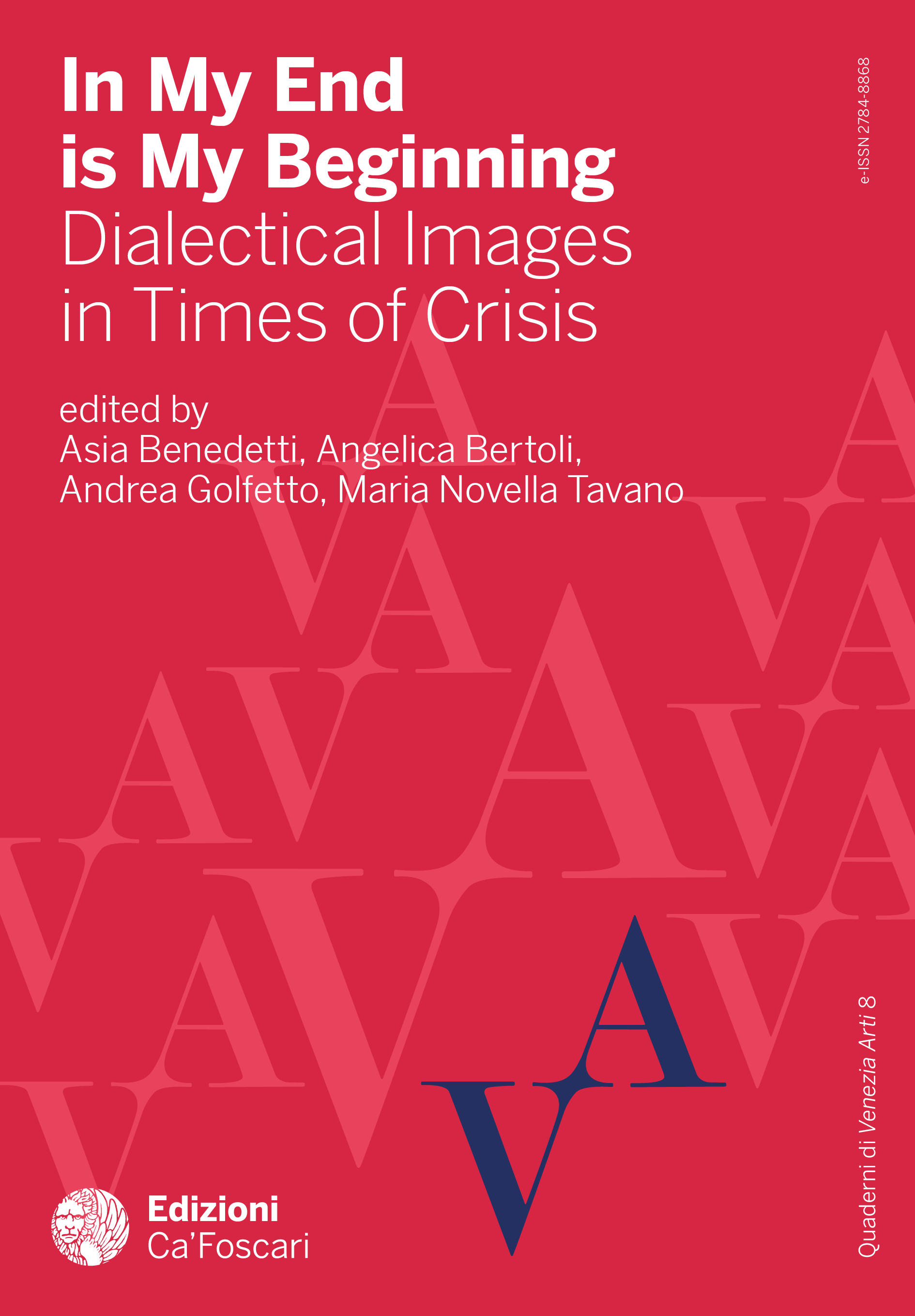
In my End is my Beginning
Dialectical Images in Times of Crisis
Edited by Asia Benedetti, Angelica Bertoli, Andrea Golfetto, Maria Novella Tavano
Book information
- Publisher
- Edizioni Ca' Foscari
- Publication
- Published 11 December 2024
- Place
- Venice, Italy
- Series
- Quaderni di <i>Venezia Arti</i>
- Catalogue record
- View in the catalogue
Abstract
The volume comprises a selection of papers presented at the 6th Postgraduate International Conference organized by the Department of Philosophy and Cultural Heritage of Ca’ Foscari University of Venice (Venice, 9-11 October 2024): In my End is my Beginning. Dialectical Images in Times of Crisis.
Both in the past and the present, humanity has been witnessing the collapse of its own identity, sociopolitical system and cultural order, as well as their restoration. In this imbalance, Ernesto De Martino acknowledges the roots of crisis, elaborating how the end of the world represents the culmination of the issue of existence, caught between the risk of downfall and the quest for redemption. At that moment, an apocalypse happens to reveal when a specific order needs to be replaced by new symbolic formations that correspond to the changed Zeitgeist. The vitality of an apocalyptic thinking, which continually transforms and produces new images of the crisis, leads us to consider a dimension in which the clash between the past and the future creates a generative power. In this liminal space between different meanings of ‘crisis’ and their translation into images, it is fundamental to consider what Walter Benjamin conceptualized as a dialectical image, a fragment wherein “what has been comes together in a flash with the now to form a constellation” (Arcades Project, 1999, 462).
The 6th Postgraduate International Conference was aimed at investigating the liminal space between different meanings of ‘crisis’ and ‘apocalypse’, discovering how, through multiple processes of translation into images, these notions reveal new, unexpected beginnings. This volume therefore investigates the image as a representation of this dialectical moment.
Where its authors and editors are based
Countries of the institutions the book's authors, editors and chapter authors were affiliated to when it was published.
- AUTHORS / EDITORS
- CITATIONS Phase 2
- USAGE Phase 3
| Country | Authors / editors |
|---|---|
| Italy | 4 |
About this data
These figures cover 1 work. Each value comes from the most trusted source that has it; a correction made by OBC staff outranks every source.
| Source | Confidence | Works |
|---|---|---|
| Thoth | 90 / 100 | 1 |
| Works with a publication date | 100% |
|---|---|
| Works with a DOI | 100% |
| Works with a funder recorded | 0% |
| Authors with an affiliation | 100% |
| Affiliations matched to an institution (ROR) | 100% |
| Affiliations with a country | 100% |
Countries come from the institution each author was affiliated to when they published, as recorded in ROR. A country is never guessed, so authors without a matched institution are not counted on the maps.
Funders come from OpenAlex for articles and Thoth for books, where publishers recorded them. Most works record none, so a funder's figures show what is recorded, not everything it funded.
Chapters count as works: their authors and editors, and the countries of their institutions, are in every figure where Thoth records an affiliation for them.
Citations (Phase 2) and usage (Phase 3) are not collected yet.