
Book view
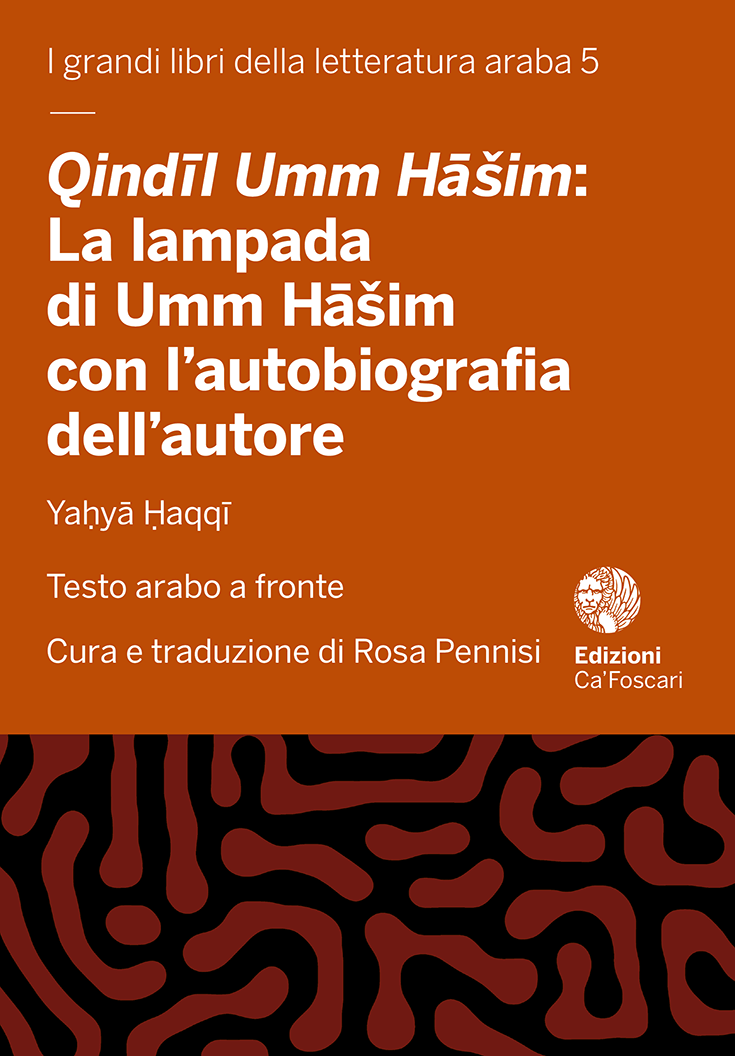
Qindīl Umm Hāšim: Umm Hāšim's Lamp with the Author's Autobiography
Edited by Rosa Pennisi; by Yaḥyā Ḥaqqī
Book information
- Publisher
- Edizioni Ca' Foscari
- Publication
- Published 14 October 2022
- Place
- Venice, Italy
- Series
- I grandi libri della letteratura araba
- Catalogue record
- View in the catalogue
Abstract
Qindīl Umm Hāšim, ‘The Lamp of Umm Hāšim’, is the title of Yaḥyā Ḥaqqī’s collection of short stories, first published in 1944, that made the author famous. Its enormous success can be traced back to the novella of the same title that opens the collection. The novella, due to its themes and narrative form, perfectly synthesizes the nationalistic spirit and modern ideals that developed in the 1920s around the al-madrasa al-ḥadīṯa movement, ‘The Modern School’, and ranks among the classics of modern Arabic fiction. It is a formally and stylistically mature work that manages to communicate in a linear and concise manner – with a formally perfect style and language that is both symbolic and direct – the spiritual, psychological and cultural complexity of the multidimensional tensions that characterise modern Egyptian reality. In 1975, following numerous reprints, an integrated edition of the collection was published containing Yaḥyā Ḥaqqī’s autobiography, which constitutes a true original essay by the author. In his autobiography Ašǧān ʿuḍw muntasib (Concerns of an affiliated member), Ḥaqqī not only reports the most important events of his life, but also offers a literary manifesto in which he confides his ideological, stylistic and literary concerns to the reader. The autobiographical manifesto emphasises how through writing (and the short story, in particular), Ḥaqqī wants to ‘shake up the Egyptian people’ so that they become aware of the socio-cultural and identity-national values that art plays in the modern era. Both his autobiography and the novella The Lamp of Umm Hāšim complement each other in capturing all the details that make up the style, ideology, innovation and commitment of a modern Egyptian intellectual. The novella – concentrated in a modest narrative space, along with Ḥaqqī’s literary manifesto – indisputably finds its place among the Great Books of Arabic Literature.
Where its authors and editors are based
Countries of the institutions the book's authors, editors and chapter authors were affiliated to when it was published.
- AUTHORS / EDITORS
- CITATIONS Phase 2
- USAGE Phase 3
| Country | Authors / editors |
|---|---|
| France | 1 |
About this data
These figures cover 1 work. Each value comes from the most trusted source that has it; a correction made by OBC staff outranks every source.
| Source | Confidence | Works |
|---|---|---|
| Thoth | 90 / 100 | 1 |
| Works with a publication date | 100% |
|---|---|
| Works with a DOI | 100% |
| Works with a funder recorded | 0% |
| Authors with an affiliation | 50% |
| Affiliations matched to an institution (ROR) | 100% |
| Affiliations with a country | 100% |
Countries come from the institution each author was affiliated to when they published, as recorded in ROR. A country is never guessed, so authors without a matched institution are not counted on the maps.
Funders come from OpenAlex for articles and Thoth for books, where publishers recorded them. Most works record none, so a funder's figures show what is recorded, not everything it funded.
Chapters count as works: their authors and editors, and the countries of their institutions, are in every figure where Thoth records an affiliation for them.
Citations (Phase 2) and usage (Phase 3) are not collected yet.