
Book view
After the Fall of the 'Ángel'
Ángel Bonomini: a Forgotten Argentinian Writer
By Alice Favaro
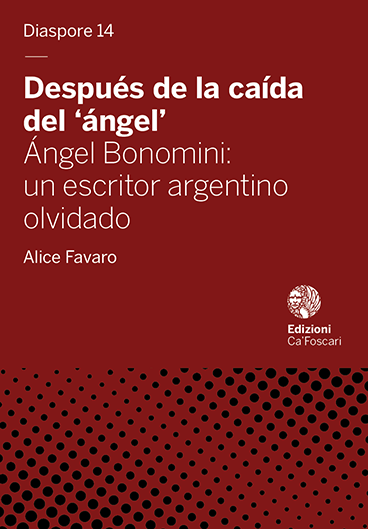
Book information
- Publisher
- Edizioni Ca' Foscari
- Publication
- Published 30 April 2020
- Place
- Venice, Italy
- Series
- Diaspore
- Catalogue record
- View in the catalogue
Abstract
Ángel Bonomini was born in Buenos Aires in 1929 where he lived until his death at the age of sixty-four in 1994. He worked for various newspapers and magazines as an art critic and translator, but always maintaining his literary activity. He inherited the tradition of the Argentine fantastic and was a prolific writer: his production includes essays, poems and fantastic tales.Although he lived in a period of great cultural splendor and his literary talent was recognised by authors such as Borges and Bioy Casares, he fell into an unexplained oblivion, disappearing quite early from the contemporary intellectual environment. His first poems, which date back to the 1950s, were published in Sur magazine and some of his tales were included in well-known anthologies of fantastic literature.Among his collections of poems there are: Primera enunciación (1947), Argumento del enamorado. Baladas con Ángel (1952) written with María Elena Walsh, Torres para el silencio (1982) and Poética (1994). In 1972 he achieved great success with the publication of his first collection of fantastic tales, Los novicios de Lerna, followed by the publication of other books: Libro de los casos (1975), Los lentos elefantes de Milán (1978), Cuentos de amor (1982), Historias secretas (1985) and Más allá del puente (1996), posthumously published.A particular use of the fantastic characterises his work and distinguishes him from his contemporary authors. In his tales there is a continuous contrast between metaphysics and existentialism; in this way, he makes a deep investigation of the reality and, at the same time, he tries to go beyond it.This volume aims to analyse some emblematic tales by Bonomini in which it is possible to find the main topoi of Argentine fantastic and to understand why the author’s literary work is worth studying.
Where its authors and editors are based
Countries of the institutions the book's authors, editors and chapter authors were affiliated to when it was published.
- AUTHORS / EDITORS
- CITATIONS Phase 2
- USAGE Phase 3
| Country | Authors / editors |
|---|---|
| Italy | 1 |
About this data
These figures cover 1 work. Each value comes from the most trusted source that has it; a correction made by OBC staff outranks every source.
| Source | Confidence | Works |
|---|---|---|
| Thoth | 90 / 100 | 1 |
| Works with a publication date | 100% |
|---|---|
| Works with a DOI | 100% |
| Works with a funder recorded | 0% |
| Authors with an affiliation | 100% |
| Affiliations matched to an institution (ROR) | 100% |
| Affiliations with a country | 100% |
Countries come from the institution each author was affiliated to when they published, as recorded in ROR. A country is never guessed, so authors without a matched institution are not counted on the maps.
Funders come from OpenAlex for articles and Thoth for books, where publishers recorded them. Most works record none, so a funder's figures show what is recorded, not everything it funded.
Chapters count as works: their authors and editors, and the countries of their institutions, are in every figure where Thoth records an affiliation for them.
Citations (Phase 2) and usage (Phase 3) are not collected yet.