
Book view
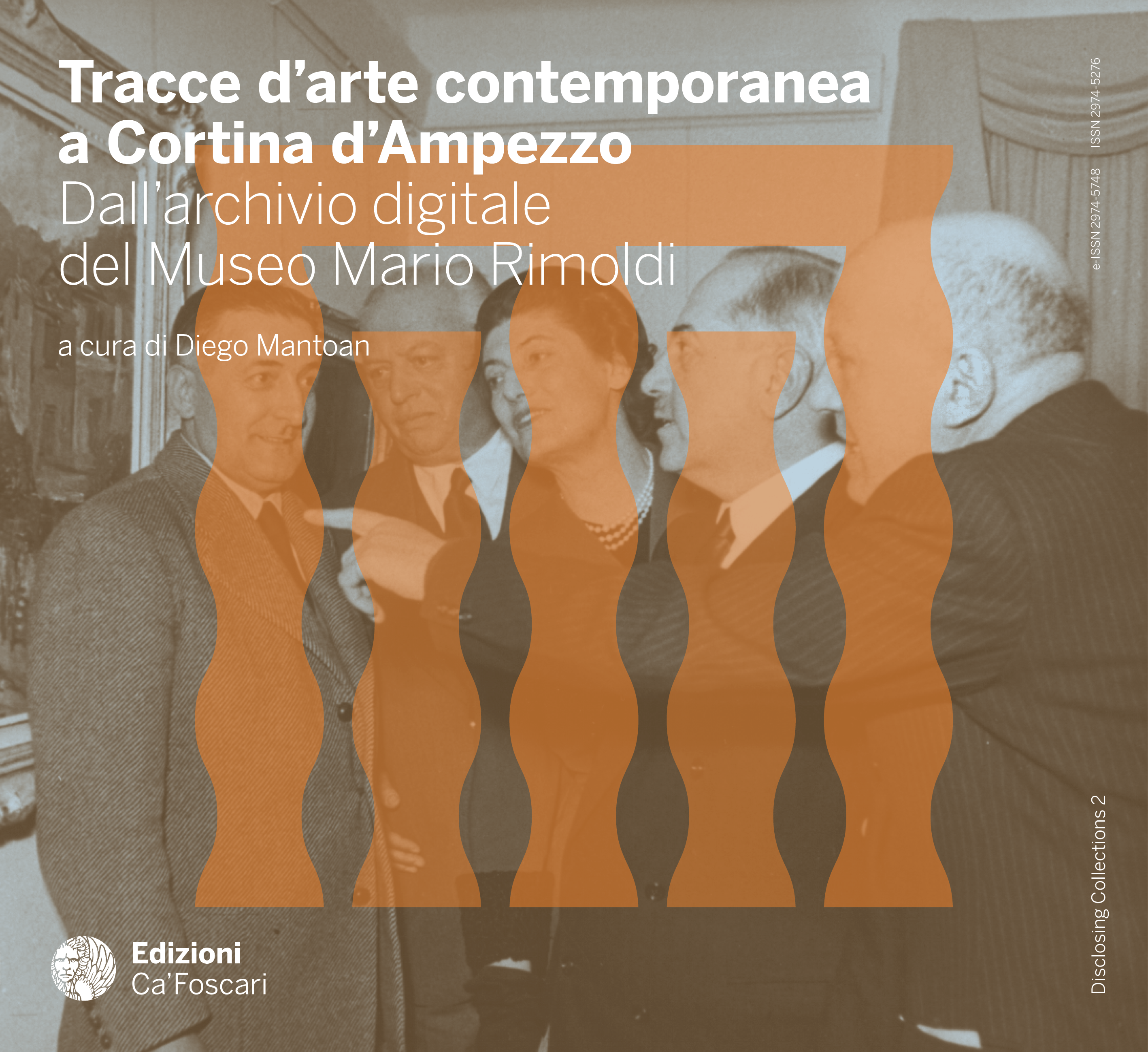
Traces of Contemporary Art in Cortina d’Ampezzo
From the Digital Archive of the Mario Rimoldi Museum
Edited by Diego Mantoan
Book information
- Publisher
- Edizioni Ca' Foscari
- Publication
- Published 5 July 2023
- Place
- Venice, Italy
- Series
- Disclosing Collections
- Catalogue record
- View in the catalogue
Abstract
In 1974, the Museum of Modern and Contemporary Art named after Mario Rimoldi, hotelier and former mayor during the 1956 Olympics, opened its doors in Cortina, as part of a much older institution, the Regole d’Ampezzo. Thus was born one of the first private museums dedicated to 20th century Italian art, the virtuous outcome of Rimoldi's own collecting activity. The Museum enriched the Ampezzo community with a patrimony that was committed to enhancing the overall artistic heritage of the Dolomite basin, projecting Cortina’s role far beyond that of nature and hospitality. However, the Museum's archival materials, including correspondences and photographs tracing the vicissitudes of one of the most refined collectors of the mid-twentieth century with masters such as Giorgio de Chirico, Filippo de Pisis, Fortunato Depero, Alis Levi and Mario Sironi, had remained unexplored until now. This volume is the result of the project to analyse and adapt the digital identity and computer systems to manage, study and enhance the rich heritage of works and archival materials of the Regole d’Ampezzo on the occasion of the fiftieth anniversary of the founding of the Rimoldi Museum. In view of this milestone, the Museum, together with the Venice Centre for Digital and Public Humanities of Ca’ Foscari University of Venice, has carried out a thorough reorganisation of its heritage by reorganising the archival fonds and transferring them to a relational database. This catalogue accompanies the new public database as a useful tool to retrace the stages and areas of the reorganisation work, while at the same time tackling stringent methodological aspects in the debate on the digitisation of the art sector. If, on the one hand, the volume provides a moment of reflection on best practices in the Digital and Public Humanities, especially in the field of relational database creation, on the other it offers a privileged opportunity to discover previously unpublished material from the Museum, capable of shedding light on its birth as well as on the Ampezzo artistic context in the 20th century. As a concrete outcome of the relational methodology adopted in the creation of the new museum database, the catalogue presents for the first time a vast iconographic apparatus composed of letters, works, documents and photographs through which to indicate research paths and valorise artistic firsts in the heritage of the Regole d’Ampezzo.
Where its authors and editors are based
Countries of the institutions the book's authors, editors and chapter authors were affiliated to when it was published.
- AUTHORS / EDITORS
- CITATIONS Phase 2
- USAGE Phase 3
| Country | Authors / editors |
|---|---|
| Italy | 1 |
About this data
These figures cover 1 work. Each value comes from the most trusted source that has it; a correction made by OBC staff outranks every source.
| Source | Confidence | Works |
|---|---|---|
| Thoth | 90 / 100 | 1 |
| Works with a publication date | 100% |
|---|---|
| Works with a DOI | 100% |
| Works with a funder recorded | 0% |
| Authors with an affiliation | 100% |
| Affiliations matched to an institution (ROR) | 100% |
| Affiliations with a country | 100% |
Countries come from the institution each author was affiliated to when they published, as recorded in ROR. A country is never guessed, so authors without a matched institution are not counted on the maps.
Funders come from OpenAlex for articles and Thoth for books, where publishers recorded them. Most works record none, so a funder's figures show what is recorded, not everything it funded.
Chapters count as works: their authors and editors, and the countries of their institutions, are in every figure where Thoth records an affiliation for them.
Citations (Phase 2) and usage (Phase 3) are not collected yet.