
Book view
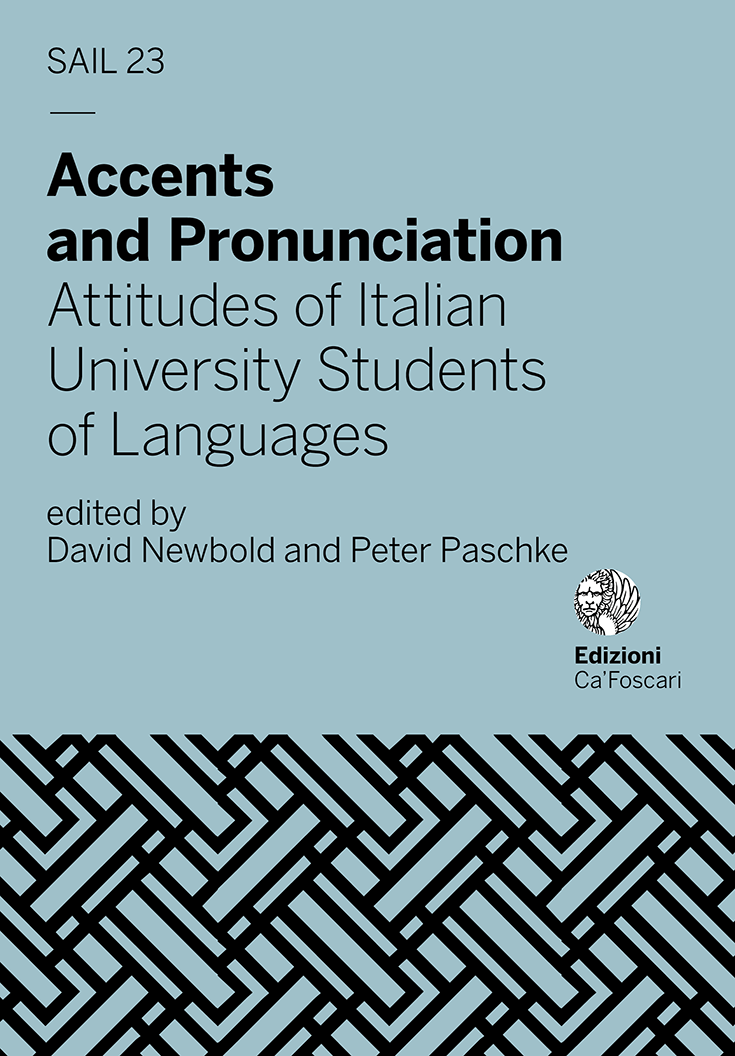
Accents and Pronunciation
Attitudes of Italian University Students of Languages
Edited by David Newbold, Peter Paschke
Book information
- Publisher
- Edizioni Ca' Foscari
- Publication
- Published 3 August 2022
- Place
- Venice, Italy
- Series
- SAIL
- Catalogue record
- View in the catalogue
Abstract
In recent years, endorsed by the updated (2018) version of the Common European Framework, intelligibility has replaced native-like pronunciation as a primary objective in foreign language teaching. But accent and pronunciation continue to be central issues for university students of languages. This volume presents the results of an investigation into the attitudes of some 370 first-year students at Ca’ Foscari University of Venice, the first such study in Italy, involving students of 13 languages, the principal ones being English, Spanish, French, German and Russian. The survey investigated the importance given to pronunciation in the foreign language, the motivation students have to improve it, and the possible conflict of identity which the acquisition of a ‘foreign’ pronunciation might incur. Students were invited to reflect on the quality and variability of their pronunciation in the two foreign languages they were studying, on their ability to assess it, on affective aspects linked to pronunciation, and on their awareness of phonetic features. They were also asked for their opinions about the pronunciation of English as a Lingua Franca (ELF) and about Italian when spoken with a foreign accent. The contributions in this volume describe the linguistic background of respondents, present and analyse the attitudes which emerge, verify the role of some independent variables (gender, plurilingualism, motivation for enrolment, languages studied, level of proficiency), and (in the case of ELF) report the findings of a follow-up study of master’s level students. The result is an overall picture likely to be of interest to anyone working in the field of university language teaching and who wishes to have a better idea of what students think about foreign language pronunciation.
Where its authors and editors are based
Countries of the institutions the book's authors, editors and chapter authors were affiliated to when it was published.
- AUTHORS / EDITORS
- CITATIONS Phase 2
- USAGE Phase 3
| Country | Authors / editors |
|---|---|
| Italy | 2 |
About this data
These figures cover 1 work. Each value comes from the most trusted source that has it; a correction made by OBC staff outranks every source.
| Source | Confidence | Works |
|---|---|---|
| Thoth | 90 / 100 | 1 |
| Works with a publication date | 100% |
|---|---|
| Works with a DOI | 100% |
| Works with a funder recorded | 0% |
| Authors with an affiliation | 100% |
| Affiliations matched to an institution (ROR) | 100% |
| Affiliations with a country | 100% |
Countries come from the institution each author was affiliated to when they published, as recorded in ROR. A country is never guessed, so authors without a matched institution are not counted on the maps.
Funders come from OpenAlex for articles and Thoth for books, where publishers recorded them. Most works record none, so a funder's figures show what is recorded, not everything it funded.
Chapters count as works: their authors and editors, and the countries of their institutions, are in every figure where Thoth records an affiliation for them.
Citations (Phase 2) and usage (Phase 3) are not collected yet.