
Book view
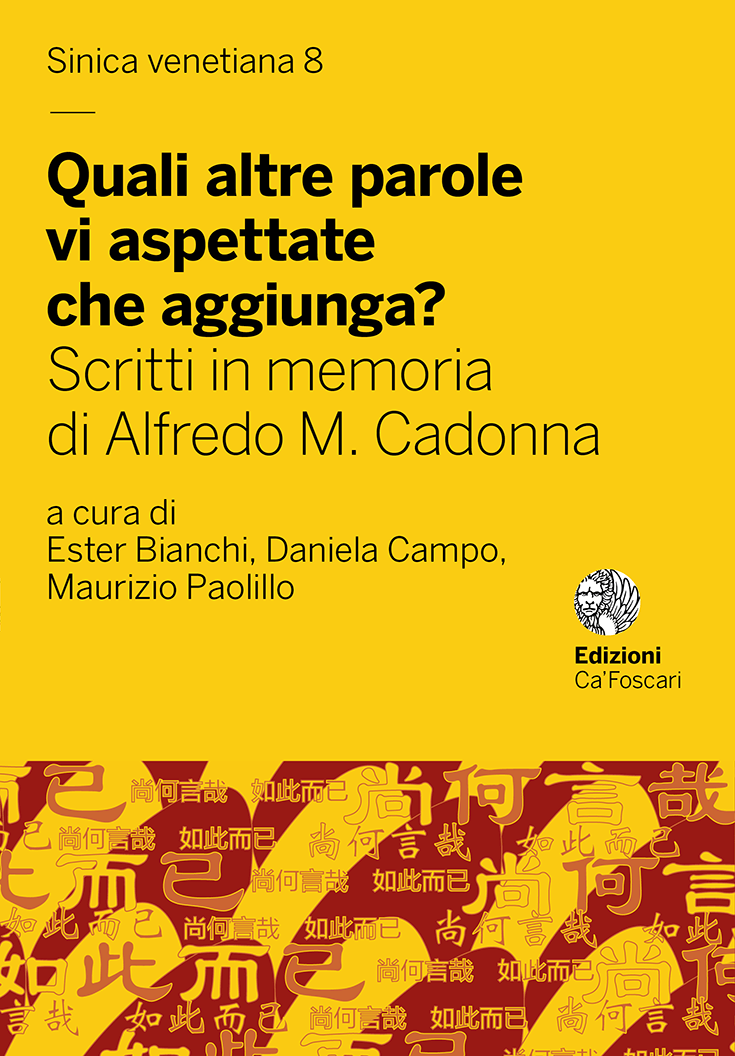
What Other Words Do You Expect Me to Add?
Writings in Memory of Alfredo M. Cadonna
Edited by Ester Bianchi, Daniela Campo, Maurizio Paolillo
Book information
- Publisher
- Edizioni Ca' Foscari
- Publication
- Published 22 December 2022
- Place
- Venice, Italy
- Series
- Sinica venetiana
- Catalogue record
- View in the catalogue
Abstract
Quali altre parole vi aspettate che aggiunga? (What more words am I supposed to say?) is a collection of essays dedicated to the memory of Alfredo Cadonna (1948-2020), philologist, translator and scholar of religions in China. The eleven chapters of this volume, authored by scholars who studied under Alfredo Cadonna, offer annotated translations of excerpts of texts belonging to different historical periods and religious and cosmological traditions. They are representative of a variety of literary genres and linguistic styles. Texts collected here include writings from archaic China, religious-themed literature composed by literati of the Empire, various types of medieval and late imperial Daoist and Buddhist works, as well as corresponding modern and contemporary examples. More precisely, the reader will find in this volume translations from the Buddhist meditation manual Shi chan boluomi cidi famen 釋禪波羅蜜次第法門 by Tiantai master Zhiyi 智顗 (538-97); religious instructions on the kan huatou 看話頭 method of meditation by Chan master Laiguo 來果 (1881-1953); one passage of the Guoyu 國語 (5th-4th centuries B.C.) dealing with the role of ‘shamans’, the relationship between spirits and human and the final ‘separation of Earth and Sky’; nineteen poems by Tang dynasty poet Wei Qumou 韋渠牟 (749-801) containing a description of the poet’s journey beyond the world of mortals; passages from the Taishang Lingbao zhicao pin 太上靈寶芝草品 and from Ge Hong 葛洪’s Baopuzi 抱樸子 (4th century) on the Daoist tradition of natural drugs zhi 芝; two chapters of the Hanlongjing 撼龍經, a fengshui classical text belonging to the School of Forms (10th century); passages from the Xiuzhen biannan 修真辨難 by Daoist master Liu Yiming 劉一明 (1734-1821); part of the Daoist text Tianxian xinchuan 天仙心傳 attributed to Min Yide 閔一得 (1758-1836) and dealing with self-cultivation and ritual practice; the Baojing sanmei 寶鏡三昧, a liturgical chant of the Chan Caodong Buddhist school attributed to the Dongshan Liangjie 洞山良价 (807- 869); a key section of the influential Buddhist Mahāyāna scripture Dasheng qixin lun 大乘起信論, an indigenous Chinese composition dating from the 6th century; and, finally, works of Liu Yiming on the specific topic of female alchemy.
Where its authors and editors are based
Countries of the institutions the book's authors, editors and chapter authors were affiliated to when it was published.
- AUTHORS / EDITORS
- CITATIONS Phase 2
- USAGE Phase 3
About this data
These figures cover 1 work. Each value comes from the most trusted source that has it; a correction made by OBC staff outranks every source.
| Source | Confidence | Works |
|---|---|---|
| Thoth | 90 / 100 | 1 |
| Works with a publication date | 100% |
|---|---|
| Works with a DOI | 100% |
| Works with a funder recorded | 0% |
| Authors with an affiliation | 100% |
| Affiliations matched to an institution (ROR) | 100% |
| Affiliations with a country | 100% |
Countries come from the institution each author was affiliated to when they published, as recorded in ROR. A country is never guessed, so authors without a matched institution are not counted on the maps.
Funders come from OpenAlex for articles and Thoth for books, where publishers recorded them. Most works record none, so a funder's figures show what is recorded, not everything it funded.
Chapters count as works: their authors and editors, and the countries of their institutions, are in every figure where Thoth records an affiliation for them.
Citations (Phase 2) and usage (Phase 3) are not collected yet.