
Book view
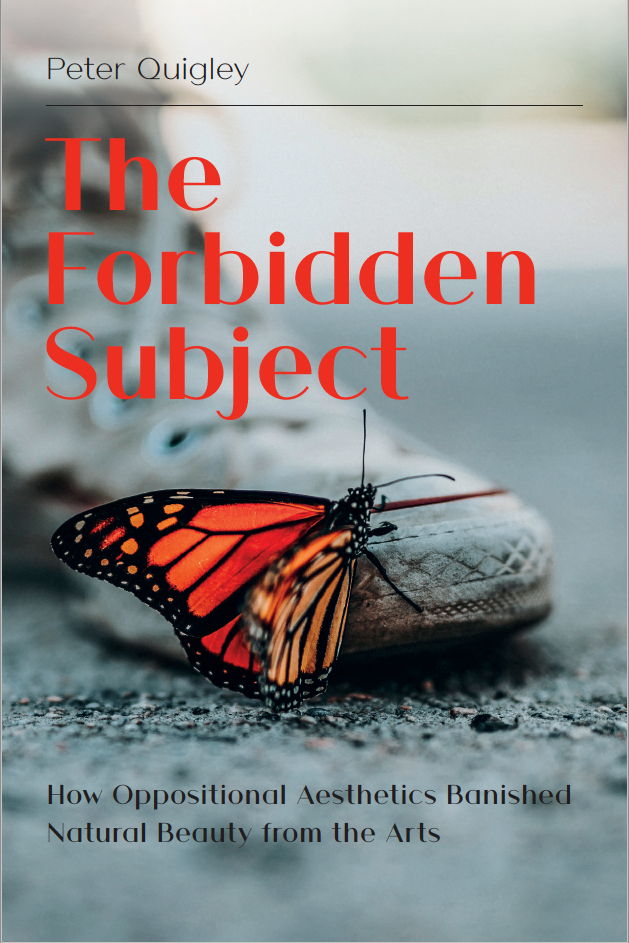
The Forbidden Subject
How Oppositional Aesthetics Banished Natural Beauty from the Arts
Book information
- Publisher
- White Horse Press
- Publication
- Published 22 July 2017
- Place
- Winwick, UK
- Catalogue record
- View in the catalogue
Abstract
"The Forbidden Subject" launches from Ed Abbey’s affirmation in Desert Solitaire: ‘This is the most beautiful place on earth’. How could such a sentiment become construed as problematic, elitist, or worse? How was a calculated and intentional attack on beauty sustained for more than a century? How did beauty become, and why does it largely remain, what Emory Elliot dubbed ‘the forbidden subject’? This book reviews the devastating impacts modernist avant-garde, Marxism, some feminisms and postmodernism have enacted – through paranoia, blame, cynicism – on beauty, hope and desire. Oppositional epistemologies deliberately eviscerated the possibilities and standing of beauty in criticism as well as in lived experience. According to Myra Jehlen, the orthodox critic thus became ‘an adversary of the work he or she analyses’, tasked with undoing the aesthetic deception of what was read to ‘expose its misrepresentations and false ideals, to strip away the lie and expose the liar’. Tracing the war on natural beauty through the literary and visual arts, The Forbidden Subject asks what it has meant for the humanities, for problem solving environmental issues, for educating students, for our personal lives and, more recently, for ecocriticism. The book asks if current ecocriticism has been misdirected by the corrosive weight of negativity – the requirement always to be ‘reading against’ – that has persisted in the arts and humanities for decades. It rehearses why a ‘return to beauty’ was imperative, and what has happened to that return since the turn of the twenty-first century. Pondering these questions, The Forbidden Subject intertwines the potential place and nature of beauty and the beauty of nature and place, concluding with a substantial reading of the poetry and thought of Robinson Jeffers.
Where its authors and editors are based
Countries of the institutions the book's authors, editors and chapter authors were affiliated to when it was published.
- AUTHORS / EDITORS
- CITATIONS Phase 2
- USAGE Phase 3
| Country | Authors / editors |
|---|---|
| United States | 1 |
About this data
These figures cover 1 work. Each value comes from the most trusted source that has it; a correction made by OBC staff outranks every source.
| Source | Confidence | Works |
|---|---|---|
| Thoth | 90 / 100 | 1 |
| Works with a publication date | 100% |
|---|---|
| Works with a DOI | 0% |
| Works with a funder recorded | 0% |
| Authors with an affiliation | 100% |
| Affiliations matched to an institution (ROR) | 100% |
| Affiliations with a country | 100% |
Countries come from the institution each author was affiliated to when they published, as recorded in ROR. A country is never guessed, so authors without a matched institution are not counted on the maps.
Funders come from OpenAlex for articles and Thoth for books, where publishers recorded them. Most works record none, so a funder's figures show what is recorded, not everything it funded.
Chapters count as works: their authors and editors, and the countries of their institutions, are in every figure where Thoth records an affiliation for them.
Citations (Phase 2) and usage (Phase 3) are not collected yet.