
Book information
- Publisher
- White Horse Press
- Publication
- Published 1 January 2013
- Place
- Winwick, UK
- Catalogue record
- View in the catalogue
Abstract
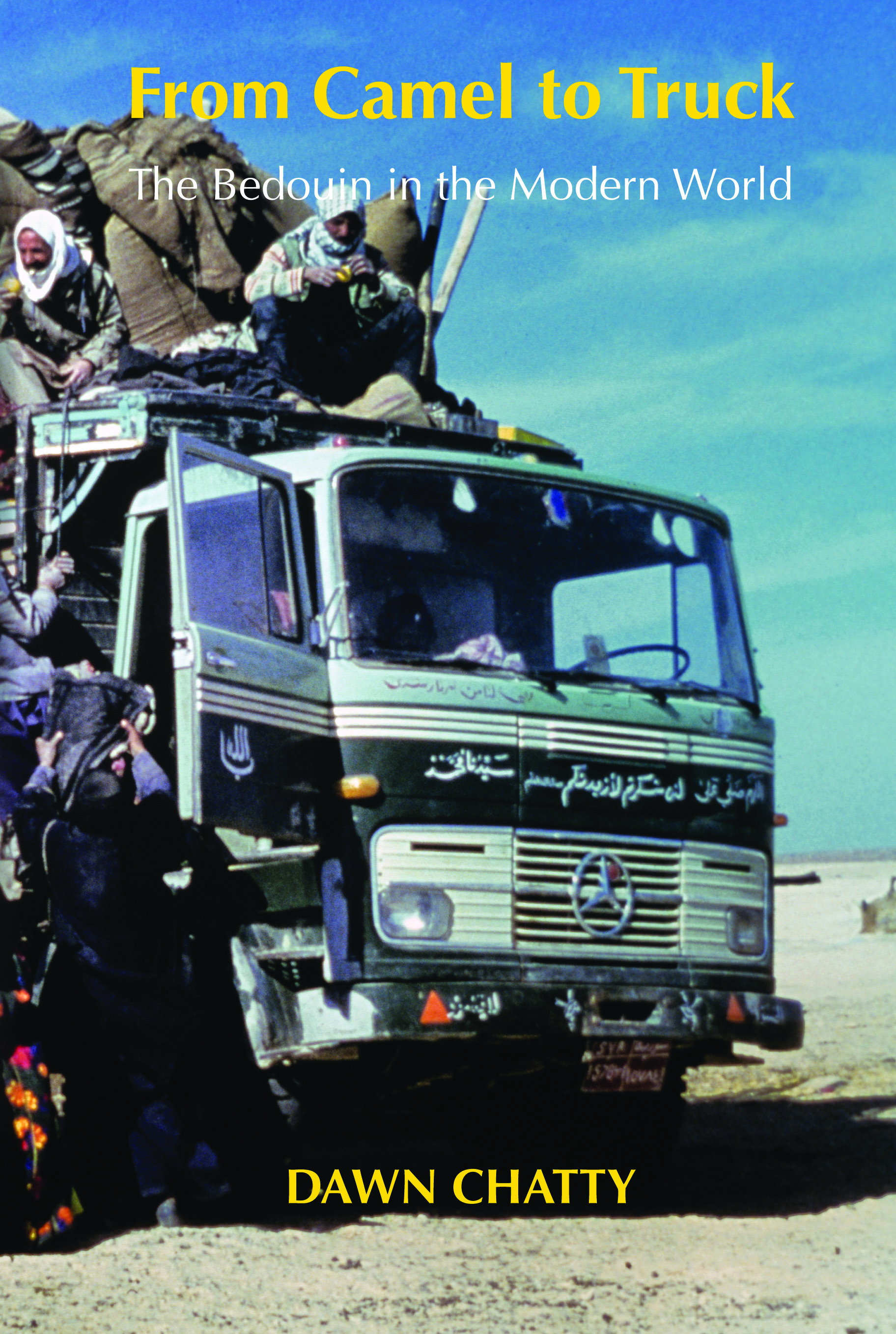
A new edition of Dawn Chatty’s seminal 1986 study of the Bedouin of Lebanon and Syria, which investigates the community’s meshing of modernity and tradition as manifested in the transition from camel to truck as primary means of transport. This is a classic study of cultural endurance and radical change in the Arabian desert.
The Bedouin tribes of Northern Arabia have lived thousands of years as pastoralists, migrating across the semi-arid badia in search of graze and browse for their herds. Romantic images of Bedouin – black tents, robed Arabs and camels – still persist. However, mobile pastoral livelihoods have come under pressure to change in recent years. The modern nation-states of the Middle East view pastoralism as anachronistic and encourage Bedouin to become settled cultivators. An even more dramatic shift has taken place within the last few decades: the Bedouin have traded in their camels as beasts of burden in favour of the half-ton truck. The ship of the desert is now a Toyota, Datsun, Nissan or General Motors pick-up. Nevertheless, many Bedouin continue to herd livestock – sheep, goat and camel – at the same time as engaging in new economic activities. They have been open to remarkable change whilst firmly holding onto their culture, and their traditional moral and value systems. The truck has allowed many the possibility of interacting with the region’s modern economy while still pursuing their mobile pastoral livelihoods.
Extensive field research underlies anthropologist Dawn Chatty’s comprehensive study. She examines contemporary Bedouin society of Lebanon and Syria in the contexts of history, economy and political and moral culture. She details the consequences of motorized transport for this community – and she draws some surprising conclusions about its future viability.
Where its authors and editors are based
Countries of the institutions the book's authors, editors and chapter authors were affiliated to when it was published.
- AUTHORS / EDITORS
- CITATIONS Phase 2
- USAGE Phase 3
| Country | Authors / editors |
|---|---|
| United Kingdom | 1 |
About this data
These figures cover 1 work. Each value comes from the most trusted source that has it; a correction made by OBC staff outranks every source.
| Source | Confidence | Works |
|---|---|---|
| Thoth | 90 / 100 | 1 |
| Works with a publication date | 100% |
|---|---|
| Works with a DOI | 0% |
| Works with a funder recorded | 0% |
| Authors with an affiliation | 100% |
| Affiliations matched to an institution (ROR) | 100% |
| Affiliations with a country | 100% |
Countries come from the institution each author was affiliated to when they published, as recorded in ROR. A country is never guessed, so authors without a matched institution are not counted on the maps.
Funders come from OpenAlex for articles and Thoth for books, where publishers recorded them. Most works record none, so a funder's figures show what is recorded, not everything it funded.
Chapters count as works: their authors and editors, and the countries of their institutions, are in every figure where Thoth records an affiliation for them.
Citations (Phase 2) and usage (Phase 3) are not collected yet.