
Book view
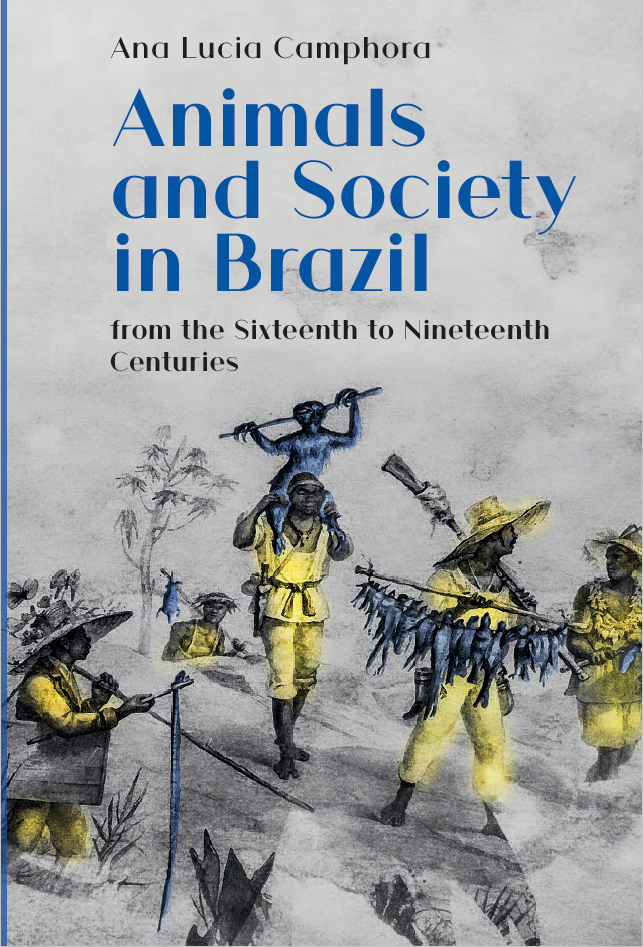
Animals and Society in Brazil
from the Sixteenth to the Nineteenth Centuries
Book information
- Publisher
- White Horse Press
- Publication
- Published 15 March 2021
- Place
- Winwick, UK
- Catalogue record
- View in the catalogue
Abstract
This pioneering overview of how social relations were constructed as interspecies relations offers the reader a starting point for bringing these encounters into a historical narrative that unfolds over the course of several centuries of Portuguese South American colonial life. In showing the decisive importance of non-human animals in the development of Brazilian society, this volume provides a point of departure for the construction of an international corpus of knowledge in the fields of environmental history and human-animal studies, adding complexity to existing narratives and throwing new light on the role of Latin American societies within the global picture. Brazil, the largest country in South America, is home to some of the planet’s richest fauna, is ranked as one of the world’s largest meat producers (beef, chicken and pork) and also has a huge population of pets, estimated at 54.2 million dogs, 39.8 million birds and 23.9 million cats, according to a 2018 survey. Non-human animals have always been there, domesticated or wild, alongside their human counterparts. These sets of relationships configure what is still a less-understood part of Brazilian history. In its six chapters, this book considers the exotic wildlife diet base adopted by European explorers; the uses of animals for medicinal purposes; intense hunting and whaling activities; and the introduction of domesticated animals from Europe and other Portuguese colonies, focusing on the decisive contributions of cattle, horses and mules in the occupation and colonisation of the extensive Brazilian territory, and the precarious system of meat supply in the-then capital, Rio de Janeiro, in the nineteenth century.
Where its authors and editors are based
Countries of the institutions the book's authors, editors and chapter authors were affiliated to when it was published.
- AUTHORS / EDITORS
- CITATIONS Phase 2
- USAGE Phase 3
| Country | Authors / editors |
|---|---|
| Brazil | 1 |
About this data
These figures cover 1 work. Each value comes from the most trusted source that has it; a correction made by OBC staff outranks every source.
| Source | Confidence | Works |
|---|---|---|
| Thoth | 90 / 100 | 1 |
| Works with a publication date | 100% |
|---|---|
| Works with a DOI | 0% |
| Works with a funder recorded | 0% |
| Authors with an affiliation | 50% |
| Affiliations matched to an institution (ROR) | 100% |
| Affiliations with a country | 100% |
Countries come from the institution each author was affiliated to when they published, as recorded in ROR. A country is never guessed, so authors without a matched institution are not counted on the maps.
Funders come from OpenAlex for articles and Thoth for books, where publishers recorded them. Most works record none, so a funder's figures show what is recorded, not everything it funded.
Chapters count as works: their authors and editors, and the countries of their institutions, are in every figure where Thoth records an affiliation for them.
Citations (Phase 2) and usage (Phase 3) are not collected yet.