
Book view
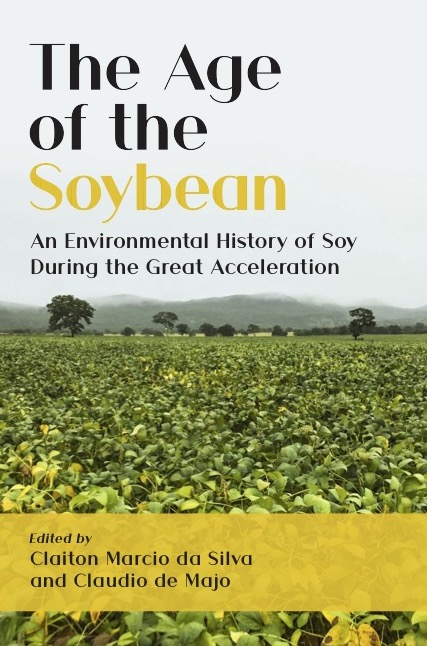
The Age of the Soybean
An Environmental History of Soy During the Great Acceleration
Edited by Claiton Marcio da Silva, Claudio de Majo
Book information
- Publisher
- White Horse Press
- Publication
- Published 1 November 2022
- Place
- Winwick, UK
- Catalogue record
- View in the catalogue
Abstract
The soybean is far more than just a versatile crop whose derivates serve the protein needs of a meatless diet. One of the world’s most important commodities, soy represents the embodiment of mechanised industrial agriculture and is one of the main actors behind the socioeconomic, political and ecological transformations of industrial farming in several world regions. Despite the crop’s potential as a cheap source of vegetal protein for human consumers, most industrial soybean production has fuelled the global meat industrial complex, as animal feed. Soybean is thus, paradoxically, still a relatively ‘invisible’ crop to the public at large, although its global yields continue to increase at stupendous rates, lining the pockets of agribusiness and to the detriment of traditional agriculture.
The transnational socio-ecological and economic entanglements characterising this versatile legume’s global expansion have prompted scholarly attention as researchers around the world have begun to unveil the main historical drivers behind the rise of the soybean in the global food chain. This book aims to expand the analysis, offering the most significant effort so far at an environmental history of soybeans. Interrogating the socioeconomic and ecological transformations determined by (and determining) the rise of soy in international food chains during the Great Acceleration, the volume gathers contributions from an international cast of researchers, working in numerous geographical contexts, from Japan and China, to India, African nations, the Southern Cone of Latin America, Northern Europe and the United States. Soybean farming, breeding, processing and marketing have bound together the histories of these diverse regions and altered beyond recognition their ecological and socio-economic contexts.
Chapters
| Chapter | Author | Institution at publication |
|---|---|---|
| Introduction | Claudio de Majo, Claiton Marcio da Silva | Ludwig-Maximilians-Universität München; Universidade Federal da Fronteira Sul |
| A History of Soy in China | Brian Lander, Thomas David DuBois | Brown University; Beijing Normal University; Hebei University |
| A Soyacene of Fire | Eduardo Relly, Claudio de Majo | Friedrich Schiller University Jena; Ludwig-Maximilians-Universität München |
| Between Brazil and Paraguay | Jó Klanovicz | Universidade Estadual do Centro-Oeste |
| Crisis Narratives from the Dutch Soyacene | Erik van der Vleuten, Evelien de Hoop | Eindhoven University of Technology; Vrije Universiteit Amsterdam |
| Domesticating the Exotic | Vimbai Kwashirai | |
| Five decades of soybean agriculture | Enrique Antonio Mejia | Stockholm University |
| From Self-Reliance to Deepening Distress | Richa Kumar | Indian Institute of Technology Delhi |
| Great Accelerations | Ernst Langthaler | Johannes Kepler University of Linz |
| Imagining Soy in Germany | Janina Priebe | Umeå University |
| Sojización as a new first movement | Matilda Baraibar Norberg | Stockholm University |
| Soy and Meat | Anna Zeide | Virginia Tech |
| Soybean as a Critical Genetic Resource | Samira Peruchi Moretto, Eunice Sueli Nodari, Rubens Onofre Nodari | Universidade Federal da Fronteira Sul; Universidade Federal de Santa Catarina |
| Soybean Cultivation and its Water-related Impacts in Brazil and the United States | Larissa de Lima Trindade, John Hoornbeek, Joshua Filla, Rodrigo Fortunato de Oliveira | Universidade Federal da Fronteira Sul; Kent State University |
| Soybean Landscapes | Jose Muzlera | National University of Quilmes; Consejo Nacional de Investigaciones Científicas y Técnicas |
| The Impact of Soybean Farming in Brazil’s Last Commodity Frontier | Cassiano de Brito Rocha, Kárita de Jesus Boaventura, Giovanni de Araujo Boggione, Sandro Dutra e Silva | Instituto Nacional de Pesquisas Espaciais; Universidade Estadual de Goiás; Universidade Evangelica de Goiás |
| The Polish-Brazilian Soy Connection | Rhuan Targino Zaleski Trindade | Universidade Estadual do Centro-Oeste |
Where its authors and editors are based
Countries of the institutions the book's authors, editors and chapter authors were affiliated to when it was published.
- AUTHORS / EDITORS
- CITATIONS Phase 2
- USAGE Phase 3
| Country | Authors / editors |
|---|---|
| Brazil | 10 |
| United States | 4 |
| Sweden | 3 |
| Germany | 2 |
| The Netherlands | 2 |
| Argentina | 1 |
| Austria | 1 |
| China | 1 |
All 9 countries
| Country | Authors / editors |
|---|---|
| Brazil | 10 |
| United States | 4 |
| Sweden | 3 |
| Germany | 2 |
| The Netherlands | 2 |
| Argentina | 1 |
| Austria | 1 |
| China | 1 |
| India | 1 |
About this data
These figures cover 18 works. Each value comes from the most trusted source that has it; a correction made by OBC staff outranks every source.
| Source | Confidence | Works |
|---|---|---|
| Thoth | 90 / 100 | 18 |
| Works with a publication date | 100% |
|---|---|
| Works with a DOI | 6% |
| Works with a funder recorded | 0% |
| Authors with an affiliation | 90% |
| Affiliations matched to an institution (ROR) | 100% |
| Affiliations with a country | 100% |
Countries come from the institution each author was affiliated to when they published, as recorded in ROR. A country is never guessed, so authors without a matched institution are not counted on the maps.
Funders come from OpenAlex for articles and Thoth for books, where publishers recorded them. Most works record none, so a funder's figures show what is recorded, not everything it funded.
Chapters count as works: their authors and editors, and the countries of their institutions, are in every figure where Thoth records an affiliation for them.
Citations (Phase 2) and usage (Phase 3) are not collected yet.