
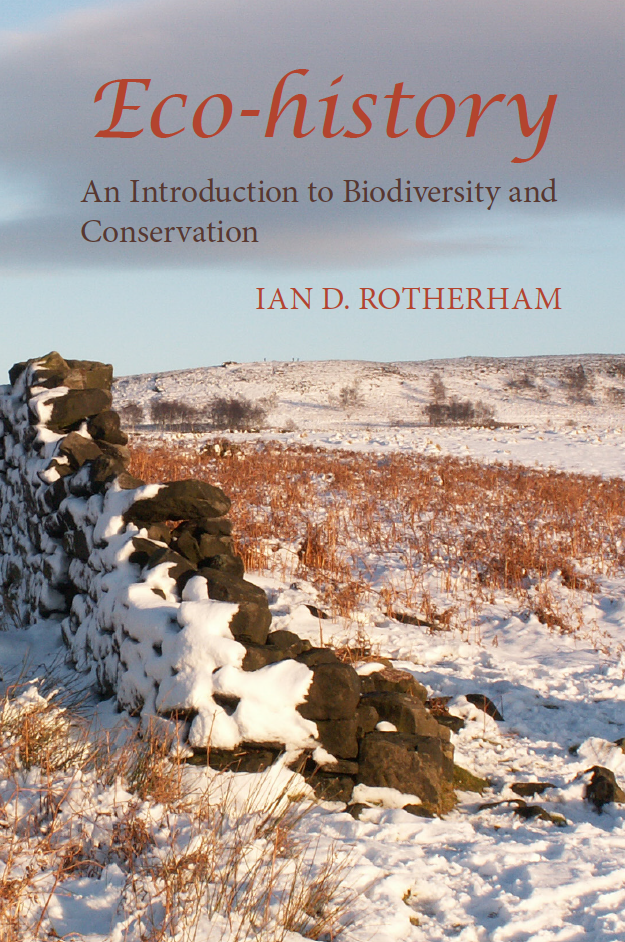
Book information
- Publisher
- White Horse Press
- Publication
- Published 1 June 2014
- Place
- Winwick, UK
- Catalogue record
- View in the catalogue
Abstract
Rotherham is convinced that to conserve wildlife or ecology, and to heal the wounds of human impacts, we must understand our own history and how, over countless centuries, we have forged today’s ecologies from our impacts on, and utilisation of, nature. He argues that the interlinked concepts of biodiversity, nature conservation and of sustainability are too often mixed with notions of ‘wilderness’ and ‘nature’ and ‘naturalness’. Much of the biodiversity that we hope to conserve is the result of long-term interactions between people and nature. It is a ‘cultural ecology’, the product of the environment, history and tradition. Recognising that the landscapes around us are ‘eco-cultural’ not ‘natural’ is, Rotherham suggests, the key to understanding contemporary biodiversity and major challenges for ideas of future conservation and sustainability.
The book introduces the background to humanity’s interactions with Nature and the forces at work in shaping today’s world. Key issues are addressed in short, focused chapters, supported by a detailed thousand-year timeline based on the British Isles. It is essential reading for anyone wishing to understand the nature of the global environmental crisis and how we got here. In particular, it will be a stimulating guide to students and teachers or lecturers from sixth form and college to university. It will also appeal to the ordinary wildlife enthusiast wishing understand the past, and to gain insight into what might be in store for the future.
Where its authors and editors are based
Countries of the institutions the book's authors, editors and chapter authors were affiliated to when it was published.
- AUTHORS / EDITORS
- CITATIONS Phase 2
- USAGE Phase 3
| Country | Authors / editors |
|---|---|
| United Kingdom | 1 |
About this data
These figures cover 1 work. Each value comes from the most trusted source that has it; a correction made by OBC staff outranks every source.
| Source | Confidence | Works |
|---|---|---|
| Thoth | 90 / 100 | 1 |
| Works with a publication date | 100% |
|---|---|
| Works with a DOI | 0% |
| Works with a funder recorded | 0% |
| Authors with an affiliation | 100% |
| Affiliations matched to an institution (ROR) | 100% |
| Affiliations with a country | 100% |
Countries come from the institution each author was affiliated to when they published, as recorded in ROR. A country is never guessed, so authors without a matched institution are not counted on the maps.
Funders come from OpenAlex for articles and Thoth for books, where publishers recorded them. Most works record none, so a funder's figures show what is recorded, not everything it funded.
Chapters count as works: their authors and editors, and the countries of their institutions, are in every figure where Thoth records an affiliation for them.
Citations (Phase 2) and usage (Phase 3) are not collected yet.