
Book view
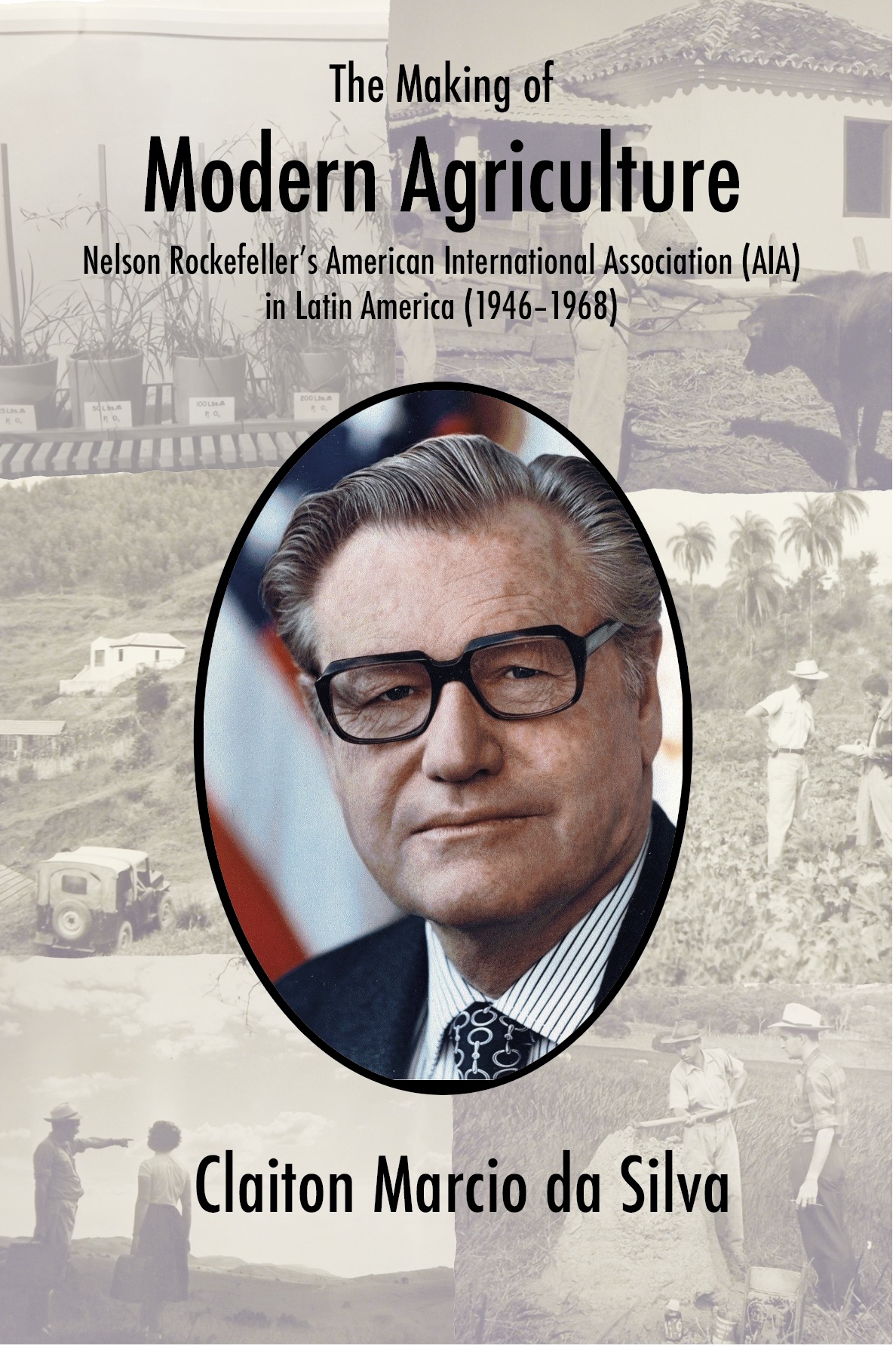
The Making of Modern Agriculture
Nelson Rockefeller’s American International Association (AIA) in Latin America (1946–1968)
Book information
- Publisher
- White Horse Press
- Publication
- Published 31 March 2023
- Place
- Winwick, UK
- Catalogue record
- View in the catalogue
Abstract
The Making of Modern Agriculture addresses how an American philanthropic agency - the American International Association for Economic and Social Development (AIA) - influenced the course of agricultural development in Latin America during the Cold War. Operating from 1946 to 1968, the AIA was an endeavour designed by the multimillionaire and politician Nelson Aldrich Rockefeller (1908-1979) to maintain the United States' influence on foreign policy through Latin America. With a major presence in Venezuela and Brazil, the AIA also conducted rural development programmes in Chile, Costa Rica, as well as studies of Trinidad & Tobago, Paraguay, Peru, China and India. With an unwavering faith in the principles of science and technology, the AIA exported experts who began their careers in reformist organisations during the New Deal and later expected to accommodate similar programmes in Latin America during and after WWII. By exploring previously unpublished primary sources, The Making of Modern Agriculture demonstrates the role of Latin American elites and governments in adapting and rejecting programmes of US origin. Based on numerous examples, the book demonstrates how the encounters and clashes between foreign experts, governments, and local technicians with affected populations resulted not only in the adaptation of exogenous projects, but, in a certain way, forced the AIA to rethink its strategies and formulate new models to be adopted later in other Southern Hemisphere countries. The book also demonstrates, from an approach mingling history of science, environment and international relations, how the encounters between experts, politicians, and rural populations rendered the notions of development and modernisation even more polysemic. Da Silva illustrates how, in addition to the notable Ford, Rockefeller and Carnegie foundations, agencies less known to academics played a differentiated and fundamental role in the geopolitics of Latin America and the United States. As the book demonstrates, the AIA is one of the fundamental references for the establishment of Harry Truman's Point Four and, among other legacies, influenced the formation of the largest agricultural extension service outside the United States, in Brazil. Finally, it contributes a historical perspective to current debates about how Latin America has become a paradoxical agricultural power, producing commodities for global markets even as environmental injustice is dramatically advancing.
Where its authors and editors are based
Countries of the institutions the book's authors, editors and chapter authors were affiliated to when it was published.
- AUTHORS / EDITORS
- CITATIONS Phase 2
- USAGE Phase 3
| Country | Authors / editors |
|---|---|
| Brazil | 1 |
About this data
These figures cover 1 work. Each value comes from the most trusted source that has it; a correction made by OBC staff outranks every source.
| Source | Confidence | Works |
|---|---|---|
| Thoth | 90 / 100 | 1 |
| Works with a publication date | 100% |
|---|---|
| Works with a DOI | 0% |
| Works with a funder recorded | 0% |
| Authors with an affiliation | 100% |
| Affiliations matched to an institution (ROR) | 100% |
| Affiliations with a country | 100% |
Countries come from the institution each author was affiliated to when they published, as recorded in ROR. A country is never guessed, so authors without a matched institution are not counted on the maps.
Funders come from OpenAlex for articles and Thoth for books, where publishers recorded them. Most works record none, so a funder's figures show what is recorded, not everything it funded.
Chapters count as works: their authors and editors, and the countries of their institutions, are in every figure where Thoth records an affiliation for them.
Citations (Phase 2) and usage (Phase 3) are not collected yet.