
Book view
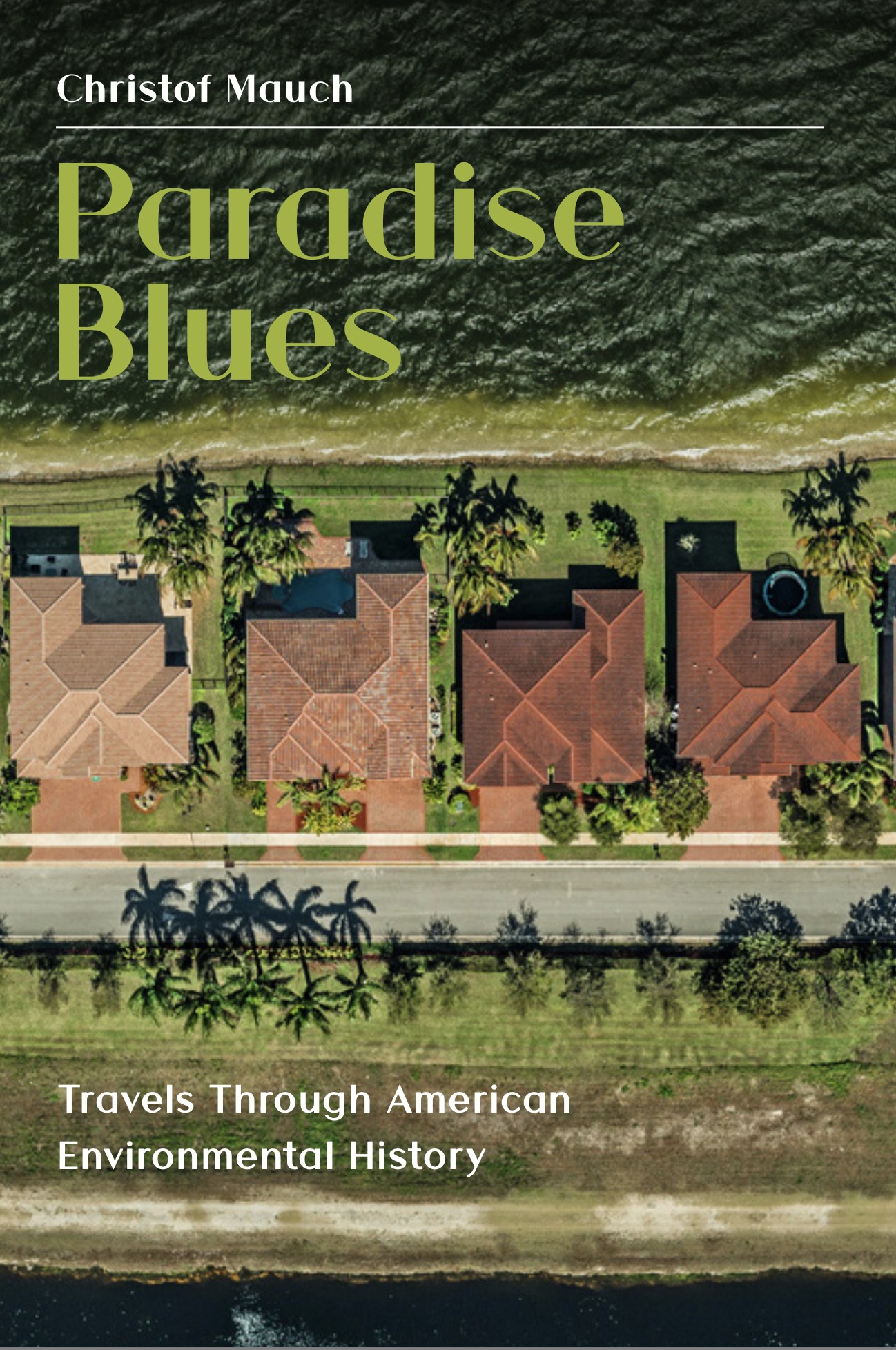
Paradise Blues
Travels through American Environmental History
Book information
- Publisher
- White Horse Press
- Publication
- Published 15 January 2024
- Place
- Winwick, Cambridgeshire, UK
- Catalogue record
- View in the catalogue
Abstract
Paradise Blues is an unconventional history of the United States of America, an unusual travel guide that follows and renders visible the country’s paths of nature, history and civilisation. Christof Mauch is a leading German historian who has spent many years in the US and in this book he attempts, from a European perspective, to grasp the diversity of American culture and the transformation of its environments, combining travel reporting with nature writing, personal observation and philosophical reflection. Mauch seeks the familiar in unfamiliar places and the curious in places that seem common and well-known.
The journey begins in tiny Wiseman, Alaska and the final portrait is of Portland, Oregon, famously America’s most sustainable city. In between, Mauch’s wanderings in space and time, his serendipitous and planned encounters with places and people, bring to light the tension and ambivalence in most Americans’ attitudes towards their often-perilous environment, the intertwining throughout history of valuation, conservation and destruction. Interactions between human beings and the environment have settled like sediment down the centuries and may be read in the present – in the form of landscapes and collective memory, in bodies of water and the earth’s strata, tree rings and human cells. One of Mauch’s dominant themes is that the grand hopes and bitter disappointments of the American paradise are not equally distributed – the blues is the voice of the dispossessed and disadvantaged; and here environmental injustice toward Black, Indigenous and other marginalised people is a recurring and haunting motif.
This is a book of melancholia and hope – Mauch exposes the beauty, the imperilment, at times the wreckage, of the American environment. And he shows us that, more powerfully than abstract ideas, governmental edicts or technological forces, stories reveal the infinite discoveries to be made in humans’ relationship to nature – in beautiful landscapes where danger lurks as well as in visions and behaviours that change the world and ecosystems. Above all, stories demonstrate that where we come from and where we are going are intimately connected and therefore nothing has to remain as it is. The stories told in Paradise Blues demonstrate that vulnerabilities and pressures are almost always political constructions and, for that reason, it must be possible to deconstruct them.
Chapters
| Chapter | Author | Institution at publication |
|---|---|---|
| Prologue | Christof Mauch | Ludwig-Maximilians-Universität München; Rachel Carson Center for Environment and Society |
| Wiseman, Alaska | Christof Mauch | Ludwig-Maximilians-Universität München; Rachel Carson Center for Environment and Society |
| Malibu, California | Christof Mauch | Ludwig-Maximilians-Universität München; Rachel Carson Center for Environment and Society |
| Memphis, Tennessee | Christof Mauch | Ludwig-Maximilians-Universität München; Rachel Carson Center for Environment and Society |
| St Thomas, Nevada | Christof Mauch | Ludwig-Maximilians-Universität München; Rachel Carson Center for Environment and Society |
| Dodge City, Kansas | Christof Mauch | Ludwig-Maximilians-Universität München; Rachel Carson Center for Environment and Society |
| Niagara, New York | Christof Mauch | Ludwig-Maximilians-Universität München; Rachel Carson Center for Environment and Society |
| Walt Disney World, Florida | Christof Mauch | Ludwig-Maximilians-Universität München; Rachel Carson Center for Environment and Society |
| Portland, Oregon | Christof Mauch | Ludwig-Maximilians-Universität München; Rachel Carson Center for Environment and Society |
| Afterword | Christof Mauch | Ludwig-Maximilians-Universität München; Rachel Carson Center for Environment and Society |
Where its authors and editors are based
Countries of the institutions the book's authors, editors and chapter authors were affiliated to when it was published.
- AUTHORS / EDITORS
- CITATIONS Phase 2
- USAGE Phase 3
| Country | Authors / editors |
|---|---|
| Germany | 1 |
About this data
These figures cover 11 works. Each value comes from the most trusted source that has it; a correction made by OBC staff outranks every source.
| Source | Confidence | Works |
|---|---|---|
| Thoth | 90 / 100 | 11 |
| Works with a publication date | 100% |
|---|---|
| Works with a DOI | 9% |
| Works with a funder recorded | 100% |
| Authors with an affiliation | 92% |
| Affiliations matched to an institution (ROR) | 100% |
| Affiliations with a country | 100% |
Countries come from the institution each author was affiliated to when they published, as recorded in ROR. A country is never guessed, so authors without a matched institution are not counted on the maps.
Funders come from OpenAlex for articles and Thoth for books, where publishers recorded them. Not every work records one, so a funder's figures show what is recorded, not everything it funded.
Chapters count as works: their authors and editors, and the countries of their institutions, are in every figure where Thoth records an affiliation for them.
Citations (Phase 2) and usage (Phase 3) are not collected yet.