
Book view
Stoneyards and Artists in Gandhara
The Buddhist Stupa of Saidu Sharif I, Swat (c. 50 CE)
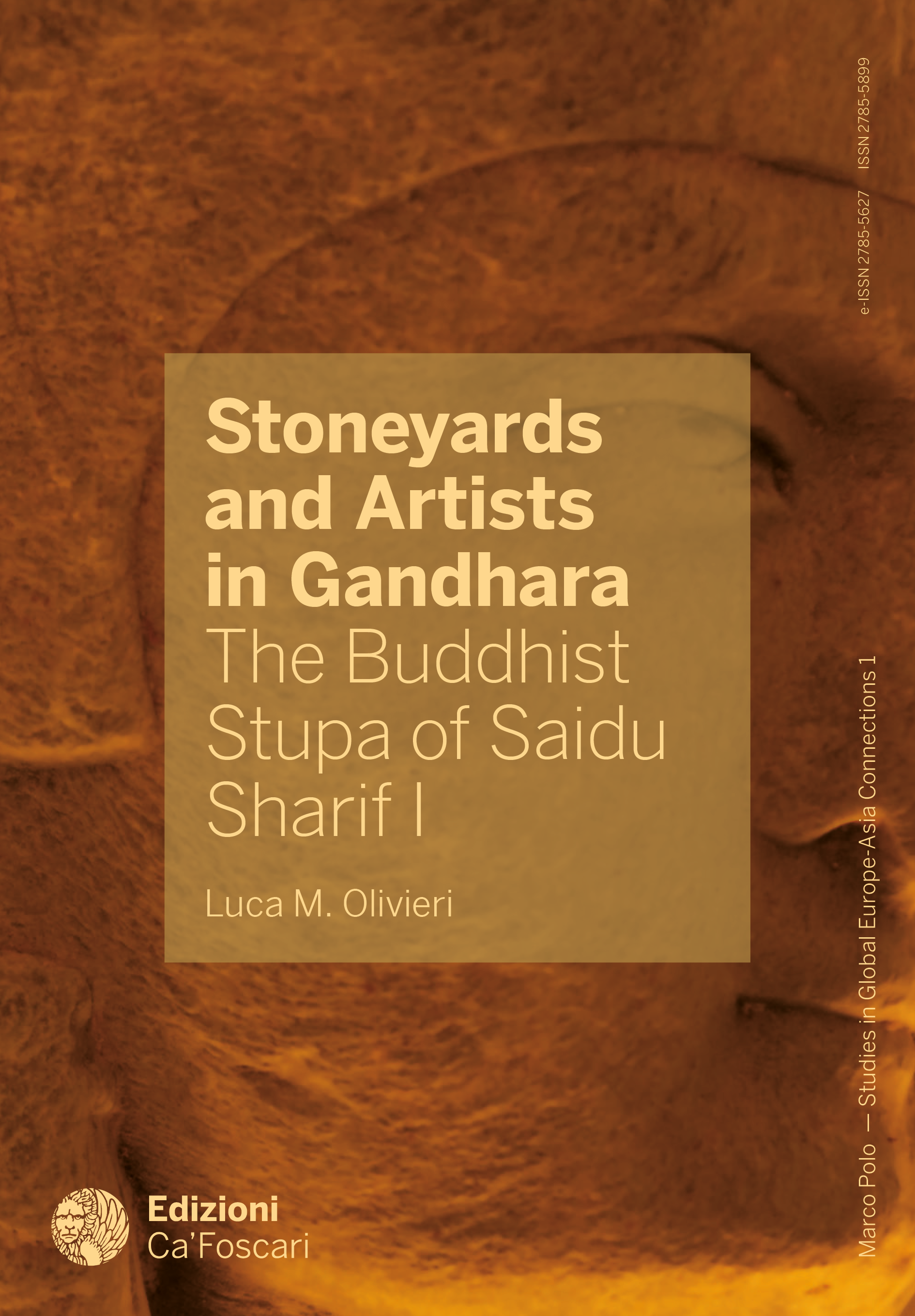
Book information
- Publisher
- Edizioni Ca' Foscari
- Publication
- Published 14 April 2022
- Place
- Venice, Italy
- Series
- Marco Polo
- Catalogue record
- View in the catalogue
Abstract
The work presented here advances a hypothetical reconstruction of the planning and programming of the building site, the executive process, the construction and decoration, and ultimately the deconsecration and abandonment of an ancient Buddhist stupa. The chronological context is that of the mid-first to the early fourth century CE. The geographical context is the fertile and rich Swat valley, at the foot of the Karakoram-Hindukush, to the north of the ancient region of Gandhara (today in Pakistan). The study is based on archaeological excavation data conducted over several seasons, including the most recent seasons from 2011 to 2014. During the latter excavations, conducted by the Author, new data that allowed additions to be made to Domenico Faccenna’s previous studies were brought to light. Among these new insights, there are some of great importance that indicate the existence of a large central niche at the top of the stupa’s upper staircase, the key to the stupa’s figurative frieze. This frieze, which represents one of the highest moments of Gandharan Buddhist art, still imitated centuries later by celebrated artists in inner Asia (at Miran), is the product of a sculptural school guided with a sure hand by an anonymous Master, to whom the responsibility for the entire project should be attributed, architect, master builder and workshop master all in one. The existence of this so-called ‘Master of Saidu’, admirably intuited and elaborated by Faccenna, finds in this volume, if possible, further support, demonstrating the capacity of the archaeological school inaugurated by Faccenna himself to answer with ongoing excavation data the many questions that the enigma of Gandhara art still poses to scholars all over the world.
Where its authors and editors are based
Countries of the institutions the book's authors, editors and chapter authors were affiliated to when it was published.
- AUTHORS / EDITORS
- CITATIONS Phase 2
- USAGE Phase 3
| Country | Authors / editors |
|---|---|
| Italy | 1 |
About this data
These figures cover 1 work. Each value comes from the most trusted source that has it; a correction made by OBC staff outranks every source.
| Source | Confidence | Works |
|---|---|---|
| Thoth | 90 / 100 | 1 |
| Works with a publication date | 100% |
|---|---|
| Works with a DOI | 100% |
| Works with a funder recorded | 0% |
| Authors with an affiliation | 100% |
| Affiliations matched to an institution (ROR) | 100% |
| Affiliations with a country | 100% |
Countries come from the institution each author was affiliated to when they published, as recorded in ROR. A country is never guessed, so authors without a matched institution are not counted on the maps.
Funders come from OpenAlex for articles and Thoth for books, where publishers recorded them. Most works record none, so a funder's figures show what is recorded, not everything it funded.
Chapters count as works: their authors and editors, and the countries of their institutions, are in every figure where Thoth records an affiliation for them.
Citations (Phase 2) and usage (Phase 3) are not collected yet.