
Book view
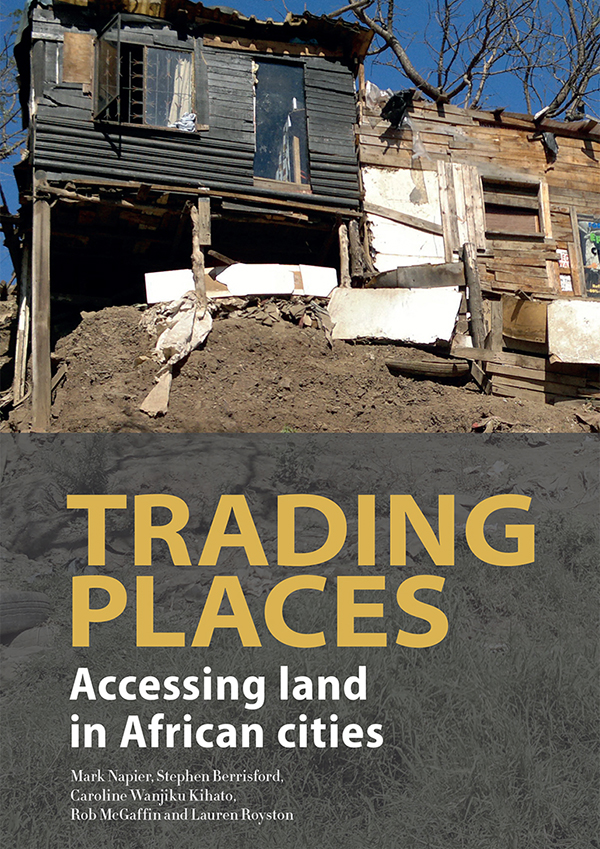
Trading Places
Accessing Land in African Cities
Edited by Mark Napier, Stephen Berrisford, Caroline Kihato, Rod McGaffin, Lauren Royston
Book information
- Publisher
- African Minds
- Publication
- Published 1 November 2013
- Place
- Cape Town, South Africa
- Catalogue record
- View in the catalogue
Abstract
Trading Places is about urban land markets in African cities. It explores how local practice, land governance and markets interact to shape the ways that people at society's margins access land to build their livelihoods. The authors argue that the problem is not with markets per se, but in the unequal ways in which market access is structured. They make the case for more equal access to urban land markets, not only for ethical reasons, but because it makes economic sense for growing cities and towns. If we are to have any chance of understanding and intervening in predominantly poor and very unequal African cities, we need to see land and markets differently. New migrants to the city and communities living in slums are as much a part of the real estate market as anyone else; they're just not registered or officially recognised. This book highlights the land practices of those living on the city's margins, and explores the nature and character of their participation in the urban land market. It details how the urban poor access, hold and trade land in the city, and how local practices shape the city, and reconfigures how we understand land markets in rapidly urbanising contexts. Rather than developing new policies which aim to supply land and housing formally but with little effect on the scale of the need, it advocates an alternative approach which recognises the local practices that already exist in land access and management. In this way, the agency of the poor is strengthened, and households and communities are better able to integrate into urban economies.
Where its authors and editors are based
Countries of the institutions the book's authors, editors and chapter authors were affiliated to when it was published.
- AUTHORS / EDITORS
- CITATIONS Phase 2
- USAGE Phase 3
No affiliations with a known country in these years yet.
About this data
These figures cover 1 work. Each value comes from the most trusted source that has it; a correction made by OBC staff outranks every source.
| Source | Confidence | Works |
|---|---|---|
| Thoth | 90 / 100 | 1 |
| Works with a publication date | 100% |
|---|---|
| Works with a DOI | 100% |
| Works with a funder recorded | 0% |
| Authors with an affiliation | 0% |
Countries come from the institution each author was affiliated to when they published, as recorded in ROR. A country is never guessed, so authors without a matched institution are not counted on the maps.
Funders come from OpenAlex for articles and Thoth for books, where publishers recorded them. Most works record none, so a funder's figures show what is recorded, not everything it funded.
Chapters count as works: their authors and editors, and the countries of their institutions, are in every figure where Thoth records an affiliation for them.
Citations (Phase 2) and usage (Phase 3) are not collected yet.