
Book view
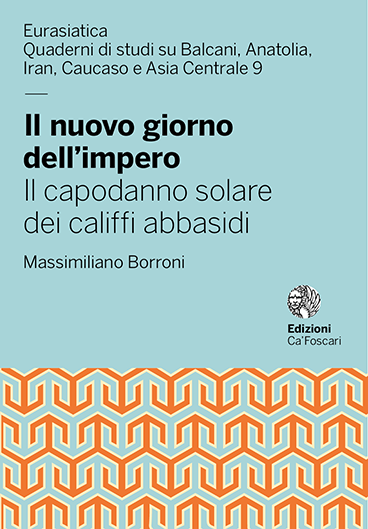
The New Day of the Empire
The Solar New Year of the Abbasid Caliphs
Book information
- Publisher
- Edizioni Ca' Foscari
- Publication
- Published 20 December 2017
- Place
- Venice, Italy
- Series
- Eurasian Studies
- Catalogue record
- View in the catalogue
Abstract
This book traces the history of the nawrūz in the Abbasid period (c. 750-1050), as it results from the study of the literary sources published in Arabic produced during the three golden centuries of the caliphate's history. It is a work based on the historical contextualisation of the numerous reports on what was a genuine caliphal New Year's of Iranian origin. The Abbasid nawrūz is studied here in the context of the courts and good society of the time, as a cornerstone of the fiscal calendar and, finally, as a popular celebration, particularly in the Mesopotamian regions.
Where its authors and editors are based
Countries of the institutions the book's authors, editors and chapter authors were affiliated to when it was published.
- AUTHORS / EDITORS
- CITATIONS Phase 2
- USAGE Phase 3
| Country | Authors / editors |
|---|---|
| Italy | 1 |
About this data
These figures cover 1 work. Each value comes from the most trusted source that has it; a correction made by OBC staff outranks every source.
| Source | Confidence | Works |
|---|---|---|
| Thoth | 90 / 100 | 1 |
| Works with a publication date | 100% |
|---|---|
| Works with a DOI | 100% |
| Works with a funder recorded | 0% |
| Authors with an affiliation | 100% |
| Affiliations matched to an institution (ROR) | 100% |
| Affiliations with a country | 100% |
Countries come from the institution each author was affiliated to when they published, as recorded in ROR. A country is never guessed, so authors without a matched institution are not counted on the maps.
Funders come from OpenAlex for articles and Thoth for books, where publishers recorded them. Most works record none, so a funder's figures show what is recorded, not everything it funded.
Chapters count as works: their authors and editors, and the countries of their institutions, are in every figure where Thoth records an affiliation for them.
Citations (Phase 2) and usage (Phase 3) are not collected yet.